
Categories
Maui Real Estate InvestingPublished August 11, 2026
Best Real Estate Investment in Maui Right Now: Why Apartment Zone Condos May Be the Biggest Opportunity

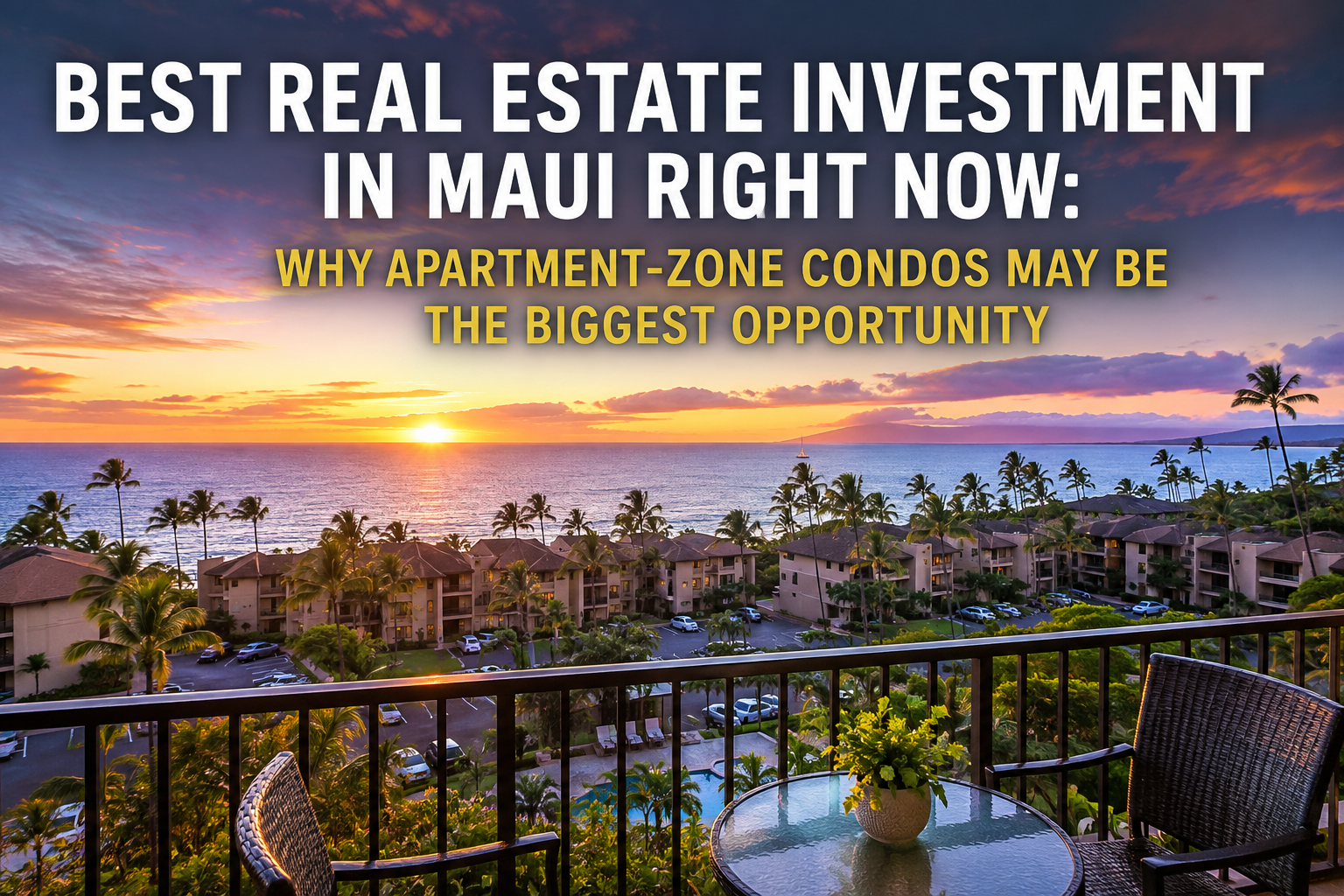
Everyone Is Worried About These Maui Condos. Here’s Why I’m Looking Closer.
There is one part of the Maui real estate market that a lot of buyers and investors are understandably nervous about right now: apartment-zoned condos with a history of short-term vacation rentals.
And I understand why.
Bill 9, changing short-term rental rules, zoning questions, and uncertainty surrounding the future of vacation rentals have changed the way buyers look at these properties.
But I’m looking at the same situation a little differently.
I believe select apartment-zoned condos could represent one of the more interesting Maui real estate investment opportunities we have seen in years.
Not because they are guaranteed to continue operating as vacation rentals.
They're not.
Not because every apartment-zoned condo is suddenly a great investment.
They're definitely not.
I'm interested because fear and uncertainty have pushed prices down dramatically in certain properties, while the underlying real estate hasn't necessarily changed nearly as much as the price.
When that happens, I start paying attention.
Todd's Quick Take
I believe select apartment-zoned Maui condos deserve a much closer look because the market is pricing substantial regulatory risk into these properties.
Some have experienced dramatic price declines while still offering excellent locations, resort-style amenities, established visitor demand, and historical rental performance.
Now add the creation of Maui's new H-3 and H-4 Hotel Districts, which could potentially provide an avenue for certain qualifying properties to pursue hotel zoning.
That doesn't make these investments safe.
It makes them interesting.
The opportunity isn't simply buying something because it is cheaper than it used to be. It's finding a property where today's price may reflect a worse outcome than what ultimately happens.
The Investment Thesis in One Sentence
I don't want to buy an apartment-zoned Maui condo simply because it's cheap. I want to find the properties where the market appears to be pricing in the worst possible outcome while the property still has multiple paths forward.
That's a huge distinction.
A condo selling for $350,000 isn't automatically a bargain because it once sold for $500,000.
Maybe $350,000 is exactly what it's worth.
But what if that same property has a strong historical rental record, a desirable Maui location, resort-style amenities, an operating model built around visitors, and a legitimate possibility of obtaining zoning more appropriate for that use?
Now the equation gets more interesting.
That's where I think the opportunity is.
Why Have Some Maui Condo Prices Fallen So Much?
The biggest issue is uncertainty.
Maui's Bill 9 changed the landscape for transient vacation rentals operating in apartment-zoned districts.
When an investor doesn't know whether a property will be legally allowed to continue its current use several years from now, that investor is going to demand a lower price today.
That's completely reasonable.
What I'm interested in is whether the market has gone too far in certain cases.
Markets don't always price uncertainty perfectly.
Sometimes buyers get so focused on the worst possible outcome that they stop considering the other possible outcomes.
And when everyone runs toward the exit at the same time, prices can disconnect from the underlying value of the asset.
That doesn't mean the market is wrong.
It means we should investigate.
Not All Apartment-Zoned Maui Condos Are the Same
This may be the most important point in this entire article.
I would never make a blanket recommendation to buy apartment-zoned condos on Maui.
There is simply too much variation between properties.
Instead, I would selectively investigate specific complexes.
Imagine two condo properties.
The first has resort-style amenities, an established history of vacation rentals, professional vacation-rental management, a visitor-oriented location, and has functioned economically much more like a resort property than traditional workforce housing.
The second looks, feels, and operates like a traditional residential condominium complex.
On paper, both could fall under the broad category of apartment zoning.
From an investment standpoint, however, they could be completely different assets.
That's why I don't think you can simply look at the words "Apartment District" and make an investment decision.
You have to look at the property itself.
Why Hotel-Like Properties Get My Attention
The properties I find most interesting are the ones where the hospitality component isn't something somebody tried to bolt onto the property later.
It's part of the property's identity.
I'm looking at things such as resort-style amenities, proximity to beaches and resort areas, historical visitor use, vacation-rental performance, management infrastructure, layouts that work well for visitors, and the overall character of the property.
Why?
Because zoning and land-use decisions don't happen in a vacuum.
If I'm evaluating the possibility that a property could eventually operate under hotel-oriented zoning, I would rather own something that already looks, feels, and functions like visitor accommodations.
That doesn't guarantee anything.
But from an investment perspective, it makes a lot more sense to me.
What Are H-3 and H-4 Hotel Districts on Maui?
This is where the conversation has become especially interesting.
Maui County has now established H-3 and H-4 Hotel Districts, creating new hotel zoning classifications that may provide a pathway for certain apartment-zoned properties affected by Bill 9 to pursue land-use changes that would allow transient vacation rental use to continue.
But there is a very important distinction investors need to understand:
Creating H-3 and H-4 zoning districts does not automatically rezone individual properties.
A qualifying property would still need to go through the applicable land-use and approval process.
That means I would not buy a property because someone says:
"It's going H-4."
Or:
"This complex is going to be rezoned."
Unless and until the required approvals occur, I would treat future zoning as a potential upside—not a guarantee.
That's also part of what creates the investment opportunity.
If everything were already decided, the uncertainty would disappear.
And there's a good chance much of the discount would disappear with it.
Maui Condo Complexes I Would Be Researching
If I were building a watchlist today, I would start by looking at properties that have historically had a strong visitor-oriented identity and investigating whether they may have a credible path forward.
Properties that have been part of the broader discussion include:
- Honokai
- Lauloa Maalaea
- Maalaea Kai
- Milowai Maalaea
- Maui Sunset
- Hale Mahina Beach Resort
- Paki Maui
- Maui Sands
- Kaanapali Royale
- Kanai A Nalu
- Wailea Ekahi
- Wailea Ekolu
- Palms at Wailea
- Mahina Surf
- Papakea
- Maui Eldorado
- Kamaole Sands
- Luana Kai
- Maui Hill
- Kahana Outrigger
- Kuleana
- Kahana Village
This is not a guarantee list, a rezoning list, or a recommendation to purchase any of these properties.
It's a research list.
Every complex needs to be evaluated individually, and every unit within that complex still needs its own financial analysis.
I would also expect this list—and my opinion of individual properties—to change as the regulatory and zoning picture continues to develop.
What Happens If a Maui Condo Doesn't Receive New Zoning?
This is the downside that every investor needs to understand before buying.
Under Maui County's current Bill 9 phase-out schedule, affected transient vacation rental uses in apartment districts may continue through December 31, 2028 in the West Maui Community Plan area, with those uses no longer permitted beginning January 1, 2029.
For the remaining areas of Maui County, the phase-out runs through December 31, 2030, with affected uses no longer permitted beginning January 1, 2031.
There are exceptions and other potential lawful pathways, which is why the exact status of an individual property needs to be verified.
But those dates are extremely important to an investor.
Why?
Because time has economic value.
If I can buy a property at a significant discount and legally generate income during the applicable period while the zoning process plays out, I don't necessarily need to assume that everything works perfectly in order to make the investment worth considering.
The purchase price matters.
The income matters.
The holding period matters.
And the value of the property under a non-vacation-rental scenario matters.
I want to understand all of them before I buy.
Maui Vista: A Real-World Example of What Gets My Attention
Let's use a one-bedroom unit at Maui Vista as an example.
If I see units trading somewhere around the mid-$300,000 range, I'm going to look closer.
Why?
Because similar units historically operated under a completely different economic model than today's pricing might suggest.
Some units have historically produced substantial gross vacation-rental revenue, with figures in the $50,000 to $60,000 annual range associated with certain units before the current market disruption.
Now, I want to be very clear about something.
Gross revenue is not profit.
You have HOA dues.
Property taxes.
Insurance.
Management fees.
Repairs.
Maintenance.
Utilities.
Furnishings.
Vacancy.
Potential assessments.
And probably a few expenses you weren't expecting, because this is Maui real estate and there are always a few surprises.
I'm also not saying an investor should assume historical revenue will automatically return.
What historical income tells me is that the property has previously supported an economic model substantially different from what today's depressed purchase price may imply.
That is enough to make me investigate further.
Three Ways I Would Underwrite the Investment
I don't like investments that require one specific outcome to succeed.
I'd rather look at three scenarios.
Scenario 1: Favorable Zoning Outcome
The property successfully obtains zoning or another lawful land-use status that allows its visitor-oriented use to continue.
If that happens, the property's income potential and market value could look dramatically different from today's distressed pricing.
That's the upside case.
Scenario 2: Extended Uncertainty
The property continues operating under whatever uses are legally permitted while owners, associations, Maui County, and other stakeholders work through the land-use process.
The property generates income during the holding period, and the investor gains more information over time.
That's the middle case.
Scenario 3: Unfavorable Outcome
The property doesn't obtain the desired zoning or another pathway for continued transient vacation rental use.
At that point, I need to know what I own.
What is it worth as a residential condo?
What rent could it generate as a long-term rental?
What are my carrying costs?
How much income did I collect before the use changed?
What is my total basis?
And most importantly:
Can I live with that outcome?
That's my rule.
I don't want to buy a property where Scenario 1 is the only way I can make money.
Four Questions I'd Ask Before Buying an Apartment-Zoned Maui Condo
Before buying one of these properties, I would want clear answers to four questions.
1. What Am I Actually Buying?
Is this fundamentally a hospitality-oriented property?
Or is it a residential condominium that happened to benefit from historical short-term rental rights?
Those aren't the same thing.
2. What Does the Zoning Picture Actually Look Like?
Forget rumors.
Forget what someone heard at the pool.
Forget what another owner posted on Facebook.
What is the property's current zoning?
What use is currently legal?
What steps would be required for a zoning change?
What is the association doing?
What has Maui County actually approved?
Those are the questions that matter.
3. What Does Today's Price Already Assume?
This is where investing gets interesting.
If a property is priced as though the worst possible outcome has already occurred—but that outcome hasn't actually occurred—you may have a margin of safety.
But you have to know the numbers.
A 40% or 50% decline doesn't automatically make something cheap.
The current price has to make sense based on realistic future scenarios.
4. Does the Deal Work Without a Perfect Outcome?
This is the big one.
If I need everything to go exactly right for the investment to work, I'm probably not interested.
I want an investment where the downside is understandable and manageable, but the upside could be significantly larger.
That's where you begin to get the asymmetric risk/reward that interests me.
The Biggest Mistake: Buying the Discount Instead of the Asset
A 50% price decline gets everyone's attention.
It should.
But it can also get investors into trouble.
The wrong question is:
"How much did this condo used to sell for?"
I care about that, but it's not the question that determines whether I buy.
The better question is:
"What is this property likely to be worth under several realistic future scenarios?"
Maybe today's price is an incredible opportunity.
Maybe it's a value trap.
My job as an investor is to figure out the difference.
Are Apartment-Zoned Condos on Maui a Good Investment in 2026?
I think select properties absolutely deserve consideration, but this is not a low-risk investment strategy.
There is regulatory uncertainty.
There is zoning risk.
There is income risk.
There is political risk.
And different properties could ultimately have very different outcomes.
That's precisely why I think the opportunity exists.
If everyone knew exactly what was going to happen, the market would price that certainty into the property.
Instead, we're looking at an unusual situation where some buyers simply don't want to touch the category at all.
That creates the possibility that the right property can become mispriced.
Can Apartment-Zoned Maui Condos Still Be Used as Vacation Rentals?
Some affected properties may continue legally operating during the applicable Bill 9 amortization period, but the answer depends on the specific property's circumstances and applicable law.
That means buyers should never assume a condo can be used as a vacation rental simply because the previous owner operated it that way.
Before buying, verify the property's current zoning, permitted use, association rules, rental history, applicable County requirements, and any pending or approved land-use changes.
This is one area where assumptions can become very expensive.
Who Is This Maui Investment Strategy For?
This strategy isn't for everybody.
If you need absolute certainty, this probably isn't where I'd point you.
I think this opportunity is more appropriate for an investor who can tolerate regulatory uncertainty, has a longer investment horizon, understands that Maui's individual submarkets behave differently, is comfortable underwriting multiple scenarios, and has enough financial flexibility that one unexpected change doesn't destroy the investment.
Most importantly, I think you need to be able to separate headlines from numbers.
Fear alone doesn't create an investment opportunity.
Fear plus a mispriced asset can.
My Take on Maui Apartment-Zoned Condos in 2026
I've been involved in Maui real estate long enough to know that the best opportunities don't always look comfortable when they first appear.
Sometimes the opportunity is obvious.
Other times it's buried underneath uncertainty.
I believe that's what we're seeing right now in parts of Maui's apartment-zoned condo market.
Bill 9 is real.
The phase-out dates are real.
The risks are real.
But H-3 and H-4 Hotel Districts have now been established, creating a potential zoning avenue that didn't previously exist in this form.
Meanwhile, some properties have experienced major price declines.
That combination gets my attention.
I'm not saying buy every apartment-zoned condo.
I'm not saying every property will be rezoned.
And I'm definitely not saying there is easy money sitting on the table.
I'm saying something much simpler:
There are properties in this market that I believe deserve a much closer look.
The right property.
At the right price.
With the right existing fundamentals.
And with multiple potential paths forward.
If those things line up, I think this could become one of the more interesting contrarian Maui real estate investment opportunities we've seen in years.
Want to Know Which Maui Condos I'm Watching?
I spend a lot of time looking at these properties—not simply at today's asking price, but at historical sales, rental performance, zoning, location, HOA structure, comparable sales, carrying costs, and what I think the property could be worth under several different scenarios.
If you're considering investing in a Maui condo and want to know which properties I think deserve a closer look, reach out.
I'll tell you what I like.
I'll tell you what I don't like.
And more importantly, I'll tell you where I think the biggest risks are.

Todd Hudson
808-344-3584
Todd@the808Team.com
The 808 Team
Maui Real Estate
WWW.The808Team.com
Important: Maui's short-term rental and zoning regulations continue to evolve. Nothing in this article is a guarantee that a particular condominium will retain transient vacation rental eligibility, receive H-3 or H-4 zoning, or achieve any particular rental income or investment return. Buyers should independently verify current zoning, permitted use, association rules, rental restrictions, County regulations, financial information, and applicable land-use approvals before purchasing. This article is for general informational purposes and is not legal, tax, or financial advice.

The 808 Team Maui
| The 808 Team | Keller Williams Realty Maui
or another way