

Categories
Maui Real Estate InvestingPublished August 20, 2026
Buying a Maui Vacation Rental? Understand This Risk Before You Close

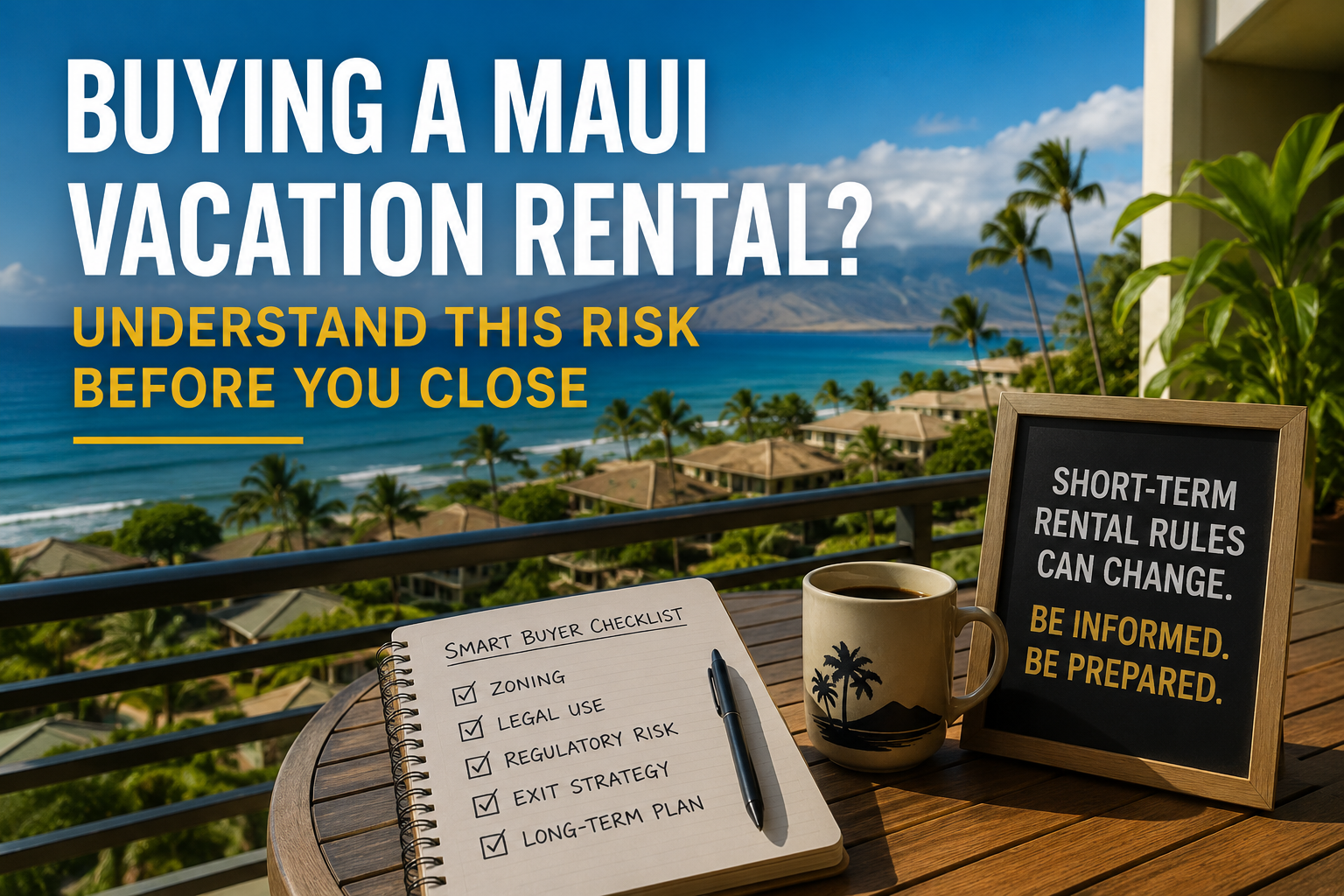
Buying a vacation rental on Maui can look incredibly attractive on paper. Strong visitor demand, limited land, beautiful locations, and the potential for substantial rental income can make these properties compelling investments.
But there is one question every buyer needs to answer before signing a contract:
What happens if Maui changes the rules after I own the property?
The answer is more nuanced than “your rental gets shut down.”
In many cases, regulatory changes come with a transition period rather than an immediate loss of rental rights. That means an owner may have years—not weeks—to decide whether to continue operating, convert the property to a long-term rental, move in, sell, or pursue another available path.
The key is knowing exactly what you are buying.
The Biggest Mistake Buyers Make
One of the easiest mistakes in Maui real estate is assuming that every vacation rental has the same level of regulatory protection.
It doesn’t.
Two condos might both be advertised as successful vacation rentals. They might both have strong occupancy, attractive amenities, and hundreds of guest reviews. But if one is hotel-zoned and the other relies on grandfathered short-term rental rights within an apartment-zoned complex, they are fundamentally different investments.
That distinction can become extremely important if the county changes the rules.
Before looking at projected rental income, look at zoning and legal use.
Think of Regulatory Risk as a Clock
When Maui changes rules affecting certain vacation rentals, the practical effect is often a phase-out period, sometimes referred to as an amortization period.
Instead of:
“You can no longer rent tomorrow.”
The scenario can be:
“You can continue operating until a specified future date.”
That difference is enormous from an investment standpoint.
Previous policy discussions and legislation have included timelines extending into future years, including deadlines around 2029 for some West Maui properties and 2031 for some South Maui properties.
For an investor, that means the important question isn’t simply whether a property’s short-term rental rights could eventually change.
It’s:
How much usable income-producing time is left, and what will I do afterward?
Start With the Property’s Zoning
Before getting excited about a rental’s gross revenue, determine what the property is actually zoned for and why it is currently allowed to operate as a vacation rental.
Generally More Protected
Properties in categories such as these are generally better positioned:
* Hotel-zoned properties
* Resort-zoned properties
* Timeshares
* Properly permitted B&Bs
* Properly permitted short-term rental homes
* Certain business-zoned properties where transient accommodations are permitted
The common thread is that visitor use is much more closely aligned with the property’s legal framework.
That doesn’t mean these properties are immune from future regulation. It means they generally aren’t dependent on the same type of grandfathered or nonconforming status.
Generally More Exposed
The bigger concern is:
* Apartment-zoned condos operating under grandfathered STR rights
* Nonconforming vacation rentals
* Properties dependent on older exceptions or legacy permissions
These are the properties where regulatory changes can have a much greater impact on future income.
What If You Buy an Exposed Property?
This doesn’t automatically mean you should walk away.
It means you need to understand the downside before you buy.
Suppose you’re considering an apartment-zoned condo that currently produces strong vacation-rental revenue.
Instead of asking only:
“How much can this make as an Airbnb?”
Ask:
“What happens if that income disappears several years from now?”
Then model the alternatives.
Scenario One: Continue Short-Term Renting
If the property remains legally eligible for vacation-rental use during a phase-out period, you may be able to continue collecting income.
That can give you time to:
* Build cash reserves
* Pay down debt
* Monitor regulatory developments
* Improve the property
* Prepare for conversion
* Sell at a strategically chosen time
The mistake is treating the remaining rental period as permanent.
Treat it as time-limited cash flow.
Scenario Two: Convert to Long-Term Rental
A property doesn’t necessarily become worthless if short-term rental use ends.
Long-term rental demand can provide another income stream.
You also need to consider the difference in operating expenses. Long-term rentals typically involve less turnover, fewer furnishings and hospitality costs, and less intensive management.
There may also be property-tax implications depending on how the property is classified and used. In certain circumstances, qualifying long-term rental or owner-occupied use may result in substantially different tax treatment, including potential homeowner exemptions.
Those numbers should be verified with the County and your tax professional before being included in an investment projection.
Scenario Three: Make It Your Maui Home
For some buyers, the backup plan is not another rental strategy at all.
It’s living there.
If you already want a Maui residence, a property that transitions from vacation rental to personal use may still have considerable value.
Owner occupancy can also change the property’s tax treatment and may provide access to applicable homeowner exemptions, subject to county requirements.
Scenario Four: Sell
Selling before a known phase-out date can be another rational strategy.
But timing matters.
As a deadline gets closer, some buyers may become increasingly cautious. Investors may demand larger discounts because they are assuming more regulatory risk.
So if selling is part of your plan, don’t wait until the final year to start thinking about it.
Rezoning Could Change the Equation
There is another variable buyers need to understand: potential rezoning.
New zoning discussions involving categories such as H3 and H4 have created potential pathways for certain apartment-zoned complexes to pursue hotel-style or visitor-oriented zoning treatment.
That could materially change the investment outlook for some properties.
But there is a major distinction between:
“This property may have a path to rezoning.”
and
“This property has been approved for rezoning.”
Those are not the same thing.
If you’re evaluating an apartment-zoned condo, investigate whether the association is actually pursuing a zoning strategy.
Ask:
* Is the HOA involved?
* Has the board taken formal action?
* Is land-use counsel involved?
* Are owners organized behind the effort?
* What stage is the process in?
* Are there known costs?
* Is there a realistic timeline?
Don’t assign full value to rezoning until it actually happens.
One More Issue Buyers Often Miss
A property’s current ability to operate as a vacation rental doesn’t necessarily mean every future owner automatically inherits every approval.
Certain permitted uses, B&B approvals, or other operating rights may have transfer requirements or may require a new owner to apply again.
This is why buyers should never rely solely on:
“The seller has been renting it for years.”
That tells you what has happened.
It does not necessarily tell you what you are legally entitled to do after closing.
Get the documentation.
Your Due-Diligence Checklist
If I were purchasing a Maui vacation rental, these would be among my first questions.
1. What is the exact zoning?
Don’t settle for a listing description.
Determine whether the property is hotel, resort, business, apartment, or another zoning classification.
2. What legally allows the current rental use?
Find out whether the property has:
* A permit
* A grandfathered right
* A nonconforming use
* A specific exception
* Another legal basis for transient rental activity
3. Is there a known phase-out date?
If there is, put it directly into your investment model.
4. Does the property work as a long-term rental?
This is one of the strongest tests of your downside protection.
If the property only works financially as a short-term rental, you’re taking substantially more regulatory risk.
5. What is the HOA doing?
For apartment-zoned condos, this can be critical.
Find out whether the association is pursuing rezoning or simply waiting to see what happens.
6. What happens if your best-case scenario doesn’t happen?
Run at least three models:
Best case: STR use continues.
Middle case: You collect STR income for several years, then transition.
Downside case: STR use ends and the property becomes a long-term rental or personal residence.
If the deal only works in the best-case scenario, that’s a warning sign.
Don’t Confuse Revenue With Profit
A property producing $50,000 or $60,000 in gross vacation-rental revenue can sound incredible.
But gross revenue is not your return.
You still need to account for:
* HOA dues
* Management
* Insurance
* Property taxes
* Utilities
* Maintenance
* Furnishing
* Repairs
* Vacancy
* Booking expenses
* Financing
A buyer should never justify a purchase solely because a unit once produced a certain amount of gross rental income.
Historical income is evidence.
It is not a guarantee.
The Question I Would Ask Before Buying
Forget the question:
“Can I make money as a vacation rental?”
Ask this instead:
“If the rules change, do I still own an asset I want to own?”
If the answer is yes, you’ve created a margin of safety.
If the answer is no, you’re making a much bigger bet on regulatory policy.
FAQ
Can Maui immediately shut down legal vacation rentals?
The more common approach has been a transition or amortization period rather than an overnight shutdown of existing legal operations. The specific timeline depends on the property and applicable rules.
Which properties generally have less regulatory exposure?
Hotel-zoned, resort-zoned, timeshare, properly permitted STR, and qualifying B&B properties generally have a stronger legal foundation for visitor use.
Which properties deserve the most caution?
Apartment-zoned condos relying on grandfathered or nonconforming short-term rental rights deserve closer scrutiny.
Should I buy a property that only works as a vacation rental?
I would be cautious. A stronger investment case exists when the property remains financially viable under a long-term rental or personal-use scenario.
Does a current STR approval automatically transfer to a buyer?
Not necessarily. Transferability should be specifically verified before closing.
Bottom Line for Buyers
Maui vacation-rental regulation isn’t simply a question of whether the rules might change.
The real question is:
What happens to your specific property if they do?
Know the zoning. Know the legal basis for the current use. Know the timeline. Understand the HOA’s position. And make sure you have a backup plan.
The safest buyer isn’t necessarily the one who finds the highest rental income.
It’s the one who understands what happens when the best-case scenario doesn’t happen.
Thinking About Buying a Maui Vacation Rental?
The right Maui vacation rental isn't just about finding the property with the highest rental income. It's about understanding what you're actually buying, how the property is zoned, what allows it to operate as a short-term rental today, and what your options are if the rules change tomorrow.
That's where having the right local guidance matters.
I've spent years helping buyers and investors navigate Maui real estate, and I'll give you the straight answer about a property—the opportunity and the risk. If you're considering a Maui vacation rental, investment condo, or second home, let's talk before you make the move.

Todd Hudson, REALTOR®
The 808 Team | Keller Williams Realty Maui
📞 808-344-3584
Ready to start looking? Call or text me at 808-344-3584 and let's find the right Maui property for you.

The 808 Team Maui
| The 808 Team | Keller Williams Realty Maui
or another way