
Categories
Maui Real EstatePublished September 2, 2026
Fee Simple vs Leasehold in Hawaii: What Buyers Need to Know Before You Buy

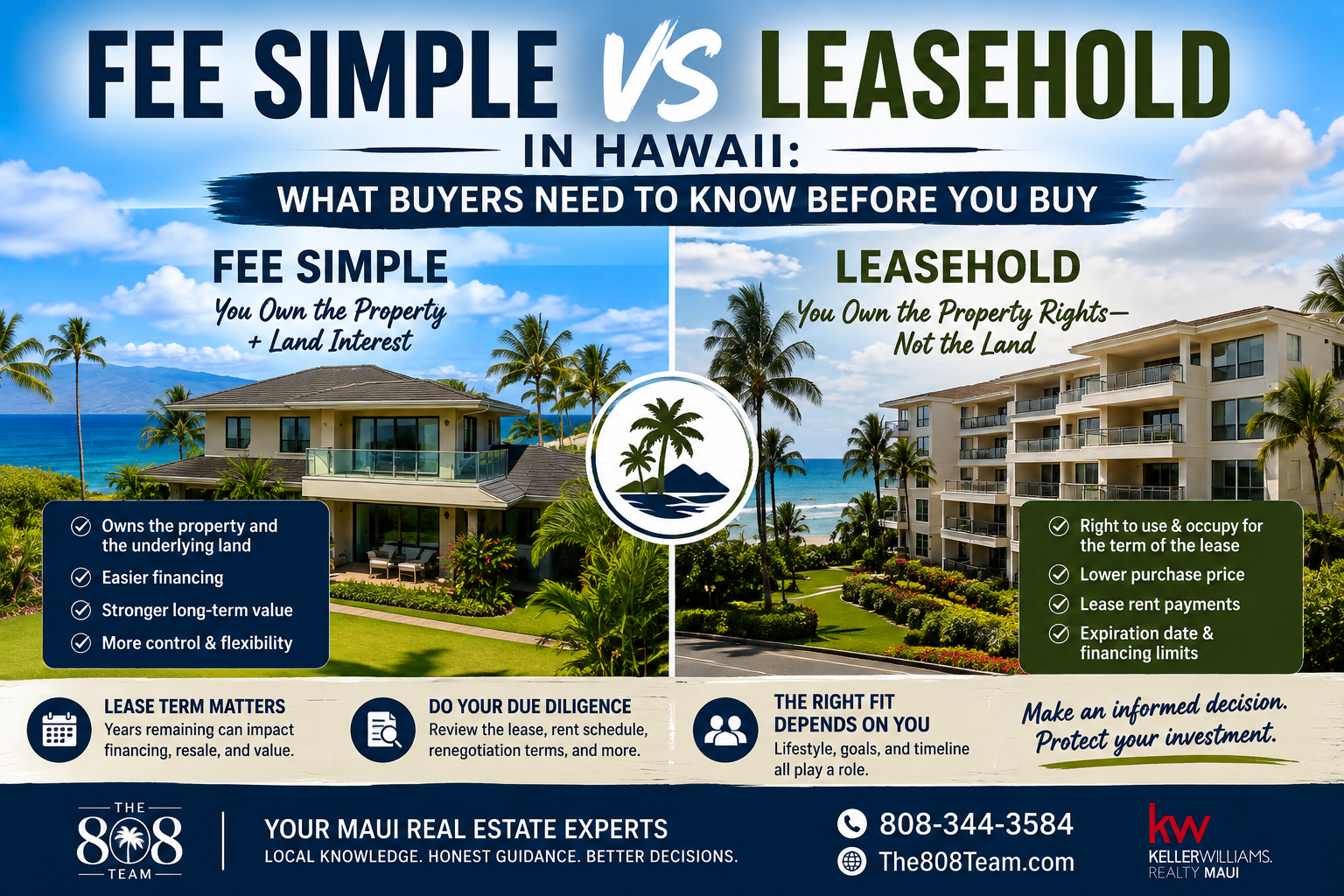
If you’re shopping for property in Hawaii and a listing looks surprisingly affordable, there’s a good chance it’s leasehold rather than fee simple.
That single detail can change your monthly costs, financing options, resale value, and long-term ownership rights. If you don’t understand the difference before you make an offer, an attractive purchase price can turn into a very expensive mistake.
Key Takeaways
• Fee simple means you own the property and the underlying land interest, subject to normal taxes, liens, zoning, and association rules.
• Leasehold means you own the right to use and occupy the property for the remaining term of a land lease, but someone else owns the underlying land.
• Leasehold properties usually have a lower purchase price, but they often come with lease rent, financing limits, and expiration risk.
• Fee simple properties usually cost more upfront, but they offer better long-term control, easier financing, stronger resale demand, and more appreciation potential.
• A cheap leasehold property is not automatically a better deal than a more expensive fee simple property.
• The years remaining on the lease matter enormously because they affect financing, resale, and value.
• In many cases, lenders want the lease to extend at least five years beyond the mortgage term.
• Leasehold can make sense for buyers focused on lifestyle, short-to-medium-term use, or lower upfront cost.
• Before buying leasehold, review the master lease, rent schedule, renegotiation terms, surrender provisions, and expiration date.
What Is Fee Simple in Hawaii?
Fee simple ownership means you own the home, condo interest, and the underlying land or proportionate interest in the land.
In practical terms, you generally have the right to sell, finance, transfer, or pass the property to heirs. Your ownership is still subject to property taxes, liens, zoning laws, condo association rules, maintenance fees, and possible special assessments.
That last point matters. Fee simple does not mean “no ongoing costs.” If you buy a condo, you can still have monthly HOA or maintenance fees, insurance costs, repairs, and association restrictions.
What Is Leasehold in Hawaii?
Leasehold ownership means you buy the right to use and occupy the property for the remaining term of a land lease, but you do not own the underlying land. Another party owns the land beneath the property.
In most leasehold situations, you own the unit or improvements, but your rights are controlled by the lease terms and the lease expiration date. You will also usually have a separate lease rent payment for the land.
This is the core issue: leasehold is tied to time. As the lease gets shorter, the value and marketability can change significantly.
Why Are Leasehold Properties So Common in Hawaii?
Leasehold exists in Hawaii because large amounts of land have historically been held by major landowners, trusts, estates, or government-related entities.
That structure allowed housing, hotels, condos, and commercial properties to be developed without selling the underlying land. It separated the building from the land ownership and often made the initial purchase price more affordable.
That affordability is exactly why many buyers consider leasehold in the first place.
Advantages of Fee Simple Ownership
Fee simple is usually the better long-term ownership structure because it gives you more control and fewer future unknowns.
Greater long-term control
Your ownership is not tied to an expiring lease. That means you’re not watching a clock that could eventually affect your rights, value, or exit strategy.
Easier financing
Lenders generally prefer fee simple. Buyers don’t have to worry about whether the lease term is long enough to satisfy mortgage requirements or whether future lease rent renegotiations will affect affordability.
Stronger resale market
There is usually a much larger buyer pool for fee simple properties. Many buyers actively avoid leasehold because they don’t understand it or don’t want the risk.
Better appreciation potential
In general, fee simple offers stronger long-term appreciation because land ownership is part of the value. Over time, that can make a major difference.
Better for estate planning
If your goal is to hold property for decades or pass it down to family, fee simple is usually the cleaner choice. You’re not dealing with a lease expiration that can complicate generational planning.
Disadvantages of Fee Simple Ownership
The main drawback of fee simple is cost.
Higher purchase price
You’re paying for the land interest, which usually means a higher sale price.
Larger down payment and financing hurdle
A higher purchase price typically means a bigger down payment, larger loan amount, and a higher barrier to entry.
Ongoing ownership costs still apply
Even with fee simple, you can still have:
• Property taxes
• HOA or maintenance fees
• Insurance
• Special assessments
• Repairs and capital improvements
Fee simple is stronger ownership, but it is not a low-cost ownership model.
Advantages of Leasehold Ownership
Leasehold can make sense when lower upfront cost matters more than long-term control.
Lower initial purchase price
This is the biggest reason buyers consider leasehold. The upfront investment is often much lower than a comparable fee simple property.
Good fit for certain lifestyles
Leasehold can work well for someone who wants to enjoy Hawaii for a defined period rather than own indefinitely.
For example, a buyer who plans to use the property for 10 to 15 years and is less concerned about leaving it to heirs may find leasehold perfectly acceptable.
Investment use can still work
From a rental standpoint, tenants usually care far more about location, condition, and price than whether the property is leasehold or fee simple.
That means some leasehold properties can still function well as:
• Vacation rentals, where allowed
• Long-term rentals
• Lifestyle-driven second homes
Possible fee purchase opportunity later
Sometimes leasehold owners are offered the chance to buy the fee interest and convert to fee simple. That can be a meaningful upside.
But this is important: never assume that will happen. Treat it as a possibility, not part of your investment thesis.
Disadvantages and Risks of Leasehold Ownership
Leasehold is a declining asset unless the lease is extended or the fee is purchased. That is the most important concept to understand.
The lease gets shorter over time
As the expiration date gets closer, value can come under pressure. The shorter the remaining lease term, the harder it often becomes to finance and resell.
Lease rent can increase
Lease rent is often based on the appraised value of the land, not your original purchase price. That means your monthly cost can rise over time.
Financing is harder
Many lenders restrict leasehold financing.
A common rule is that the lease needs to expire at least five years after the mortgage term ends. For example:
• 30-year mortgage = about 35 years left on the lease
• 20-year mortgage = about 25 years left
• 15-year mortgage = about 20 years left
That alone can shrink your financing choices dramatically.
Smaller buyer pool
When it’s time to sell, fewer buyers may be willing or able to purchase a leasehold property. Some buyers avoid leasehold entirely.
The fee may never be offered
Some buyers assume they will eventually get a chance to buy the land interest. Sometimes that happens. Sometimes it does not.
Expiration risk is real
If the lease expires and is not extended, the leasehold interest may terminate. You need to understand exactly what the lease says happens to the unit and improvements at that point.
This is not a detail to skim past.
How to Compare Fee Simple vs Leasehold the Right Way
Do not compare purchase price alone. Compare the total ownership picture.
A $400,000 leasehold property is not automatically a better deal than a $650,000 fee simple property.
You need to compare:
• Purchase price
• Down payment
• Mortgage payment
• Interest rate
• Monthly lease rent
• HOA or maintenance fees
• Property taxes
• Special assessments
• Insurance
• Expected resale value
• Years remaining on the lease
One major difference is that with fee simple, you can eventually pay off the mortgage and eliminate that loan payment. With leasehold, you may still have ongoing lease rent even after the mortgage is gone.
Questions to Ask Before Buying a Leasehold Property
If you’re considering leasehold, these questions are non-negotiable.
• Who owns the underlying land?
• Exactly when does the lease expire?
• How many years will remain when I plan to sell?
• What is the current monthly lease rent?
• When is the next lease rent renegotiation?
• How is lease rent calculated?
• Does the lease contain surrender or reversion provisions?
• What happens to the unit and improvements when the lease expires?
• Can the lease be extended?
• Is an extension guaranteed, likely, or only being discussed?
• Is the fee interest available now or expected to be offered later?
• What mortgage terms are available today?
• Are there restrictions on renting, selling, remodeling, or transferring the property?
• Are there pending lawsuits or negotiations involving the lease?
• How have lease rents and resale values performed in the same project?
If you don’t have clear answers to these questions, you don’t fully understand what you’re buying.
Documents You Should Review Carefully
The lease documents matter as much as the property itself.
Before moving forward, review:
• The master land lease
• All amendments to the lease
• The lease rent schedule
• Rent renegotiation provisions
• Expiration terms
• Surrender or reversion language
• Condo documents and association rules
• Any active legal disputes tied to the land lease
This is an area where buyers should slow down, read carefully, and get professional guidance.
When Leasehold Makes Sense
Leasehold can be a reasonable choice in the right situation.
It often works best for:
• Buyers prioritizing lifestyle over long-term appreciation
• Buyers planning to own for a defined period
• Cash buyers who fully understand declining lease value
• Buyers who want access to Hawaii real estate at a lower entry price
• People with no need for long-term estate planning through the property
The best leasehold buyer is usually someone making a deliberate, informed lifestyle decision.
When Fee Simple Is the Better Choice
Fee simple is usually the stronger option for buyers thinking long term.
It is often best for:
• Long-term owner-occupants
• Buyers focused on appreciation
• Buyers who want easier financing
• Families thinking about estate or generational planning
• Buyers who want the broadest future resale market
• Anyone who wants fewer moving parts and less uncertainty
If long-term control matters most, fee simple usually wins.
Common Mistakes Buyers Make
The biggest mistake is focusing on the low listing price and ignoring the lease details.
Other common mistakes include:
• Assuming leasehold is automatically a bad investment
• Assuming fee simple is automatically a good investment
• Ignoring lease rent increases
• Failing to calculate total monthly ownership cost
• Not checking the remaining lease term
• Assuming the fee interest will eventually be available
• Not understanding financing limits before making an offer
• Skipping review of surrender and expiration provisions
The risk is rarely the word leasehold itself. The risk is buying it without understanding exactly how the lease works.
FAQ
Is leasehold property in Hawaii a bad investment?
Not necessarily. Leasehold can make sense if the purchase price is low enough, the lease term is long enough, and the property fits your goals. It becomes risky when buyers ignore the expiration date, lease rent, and resale limitations.
Is fee simple always better than leasehold?
Not automatically. Fee simple is usually better for long-term control, appreciation, and financing, but leasehold may fit buyers who prioritize lower upfront cost or shorter-term lifestyle use.
Can you get a mortgage on a leasehold property in Hawaii?
Yes, sometimes. But financing is usually more limited, and many lenders require the lease to extend at least five years beyond the mortgage term.
Do leasehold owners pay HOA or maintenance fees?
Yes. Leasehold does not replace normal condo or association costs. In many cases, you pay maintenance fees and lease rent.
What happens when a leasehold lease expires?
That depends on the lease terms. The leasehold interest may terminate unless the lease is extended or the fee interest is purchased. You need to review the lease carefully to understand what happens to the unit and improvements.
Can a leasehold property become fee simple?
Sometimes. Owners may be offered the chance to buy the fee interest, but you should never assume that will happen.
Final Thoughts
The right question is not whether fee simple or leasehold is universally better. The right question is which one fits your goals, timeline, financing, and risk tolerance.
If you want long-term ownership, stronger appreciation potential, easier financing, and a cleaner resale path, fee simple is usually the safer and stronger choice.
If you want a lower entry price and you fully understand the lease terms, leasehold can still work. But you need to evaluate the entire deal, not just the sticker price.
Before you buy, compare the full monthly cost, read the lease carefully, and make sure you know exactly how many years are left on that clock.
Not Sure if a Hawaii Property Is Fee Simple or Leasehold?
If you've found a Maui property that looks like an incredible deal, there's a reason I always tell buyers to look beyond the asking price.
Fee simple versus leasehold can dramatically change the true cost of ownership, financing options, resale potential and what you're actually buying.
Before you make an offer, let's look at the entire picture—the ownership structure, remaining lease term, lease rent, HOA fees, financing options and what that property could realistically be worth when you're ready to sell.
I've helped buyers navigate Maui real estate for years, and my job isn't just to help you find a property. It's to help you understand exactly what you're buying before you own it.

Todd Hudson, REALTOR®
The 808 Team | Keller Williams Realty Maui
📞 808-344-3584
Thinking about buying on Maui? Call or text me at 808-344-3584 and let's talk about what you're looking for.

The 808 Team Maui
| The 808 Team | Keller Williams Realty Maui
or another way