
Categories
Buying Maui Real EstatePublished September 1, 2026
Hidden Costs of Owning Property on Maui: What Buyers Need to Budget For

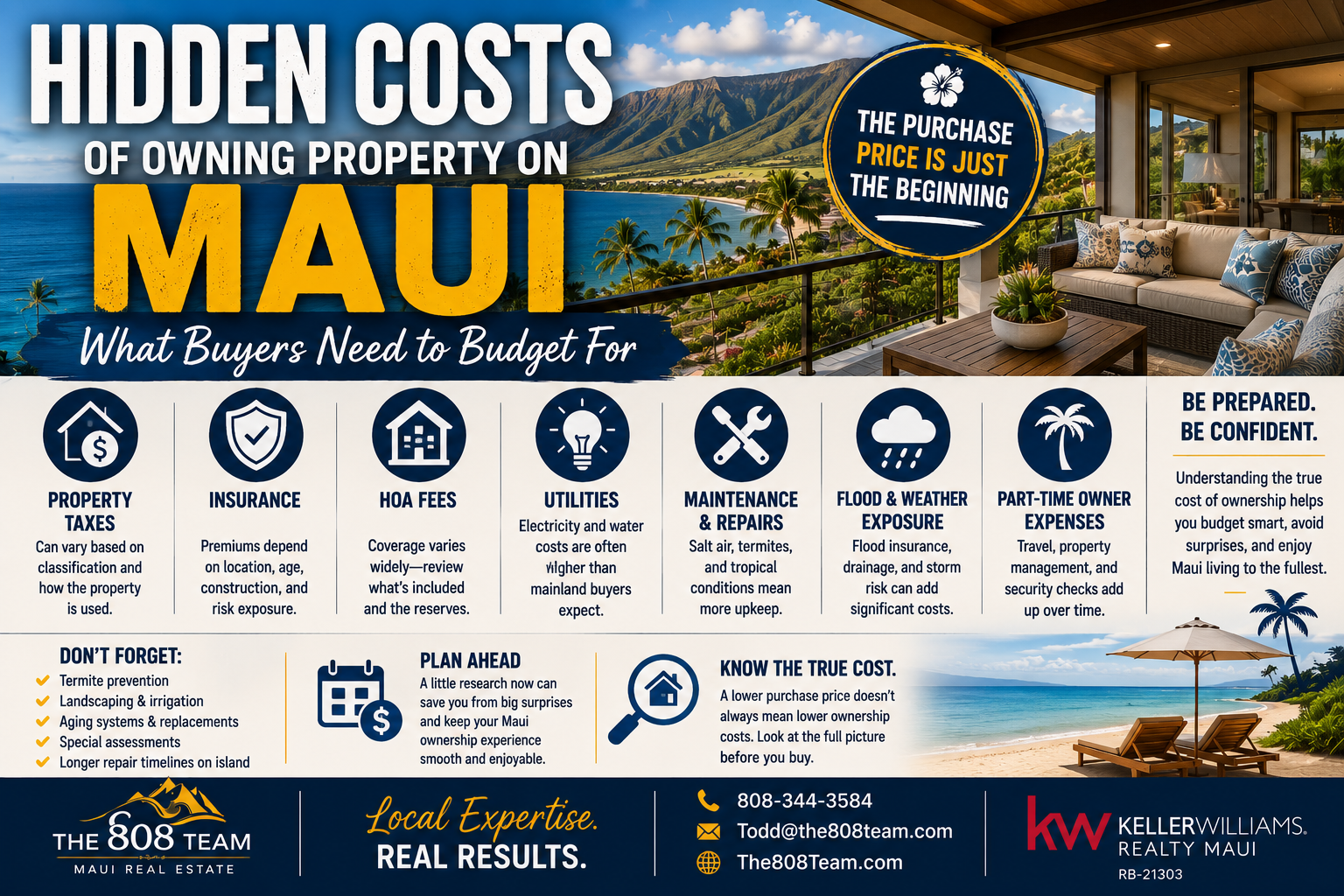
Hidden Costs of Owning Property on Maui: What Buyers Need to Budget For
Owning a home or condo on Maui can be an incredible lifestyle upgrade.
You get beautiful weather, world-class beaches minutes away, and the kind of daily rhythm that's hard to duplicate almost anywhere else.
But here's something I want every Maui buyer to understand before they make an offer:
The purchase price is only the beginning.
If you budget for the down payment and mortgage without planning for the real cost of owning property on Maui, you can get surprised pretty quickly after closing.
The goal of this article isn't to scare you away from buying.
It's exactly the opposite.
I want you to understand the numbers before you buy so you can enjoy the property after you own it.
What Are the Hidden Costs of Owning Property on Maui?
Beyond your mortgage, Maui property owners may need to budget for:
- Property taxes
- Homeowners insurance
- HOA fees
- Utilities
- Salt-air maintenance
- Landscaping
- Termite prevention
- Flood insurance
- Major system replacements
- Special assessments
- Property management
- Travel and oversight for part-time owners
- Higher costs and longer timelines for certain repairs
Some of these expenses apply to almost everyone.
Others depend heavily on the property.
That's why I don't think there is one universal answer to:
"How much does it cost to own a home on Maui?"
The better question is:
"What will it cost to own this particular Maui property the way I intend to use it?"
That's what we need to figure out before you buy.
Maui Property Taxes Aren't One-Size-Fits-All
Property taxes are one of the first things I tell buyers to investigate.
Two Maui properties with similar values can have very different tax bills.
Why?
Classification and use matter.
A property may be treated differently depending on whether it is:
- Owner-occupied
- Used as a second home
- Rented long term
- Operated as a short-term vacation rental
- Classified in another applicable tax category
That's why you should never look at the seller's current tax bill and automatically assume yours will be the same.
The seller may be using the property differently than you intend to.
Before You Buy, Find Out:
How is the property currently classified?
Could that classification change after I purchase it?
How will my intended use affect the tax bill?
What should I realistically budget annually?
That last question is the important one.
A property can fit comfortably within your purchase budget but not within your ownership budget.
Those are two very different things.
Homeowners Insurance Has Become a Major Part of the Conversation
Insurance deserves serious attention before buying Maui real estate.
The cost and availability of coverage can vary substantially based on the individual property and its risk profile.
That becomes especially important with:
- Shoreline properties
- Condominiums
- Older homes
- Properties with greater fire exposure
- Properties in flood-sensitive areas
Factors that may affect insurance include the property's location, construction, age, roof condition, flood exposure, fire risk, claims history and other property-specific characteristics.
My Simple Rule
Get insurance information and quotes as early in the transaction as possible.
Don't wait until you're almost ready to close to find out what coverage is available and what it may cost.
Insurance should be part of the buying decision—not a surprise at the end.
Maui Condo HOA Fees: Don't Just Look at the Number
If you're buying a Maui condo, you're probably going to have HOA fees.
Buyers naturally look at the monthly number first.
$900 a month.
$1,500 a month.
$2,000+ a month.
And immediately decide whether the HOA is "high" or "low."
I think that's the wrong way to analyze it.
The more important question is:
What does the HOA fee actually cover?
Depending on the complex, HOA fees may include some combination of:
- Water
- Sewer
- Trash
- Landscaping
- Exterior maintenance
- Common-area maintenance
- Building insurance
- Roof expenses
- Pools
- Amenities
- Cable
- Internet
Other associations may cover far less.
So a higher HOA fee isn't automatically bad.
If that fee covers expenses you'd otherwise have to pay separately, it may actually make your monthly ownership costs more predictable.
Don't ask only, "How much is the HOA?"
Ask:
"What am I getting for it?"
I've gone deeper into this specifically for condo buyers in my Hidden Costs of Owning a Condo on Maui in 2026 guide.
The HOA Fee Isn't the Only HOA Number That Matters
This is important enough to separate from the monthly dues.
I also want to know about:
Reserves.
Master insurance.
Upcoming capital projects.
Deferred maintenance.
Special assessments.
Litigation.
A condo with relatively low monthly dues can become extremely expensive if the association hasn't adequately planned for major future repairs.
Meanwhile, an association with higher dues but strong reserves and well-maintained buildings may provide greater predictability.
This is why I want to review the financial health of the association, not simply the monthly HOA amount.
Maui Utilities Can Surprise Mainland Buyers
Electricity is one area where mainland buyers can experience some sticker shock.
Water can matter too, particularly with larger homes, pools and substantial landscaping.
When I'm comparing properties, I want to know:
- Historical electric usage
- Water usage
- Number and type of air-conditioning systems
- Energy efficiency
- Whether solar is installed
- Whether the solar system is owned or leased
- Whether battery storage exists
- Age and condition of the solar/battery system
A home with a well-designed solar and battery system may have a very different operating-cost profile from a similar property without one.
The exact savings depend on the system and how the owner uses the property, so I wouldn't assume a universal dollar amount.
But energy efficiency absolutely belongs in the comparison when you're deciding between Maui homes.
Salt Air Is Amazing—Until It Meets Metal
Everyone wants to be near the ocean.
I understand why.
But the closer you get to the water, the more attention you need to pay to maintenance.
Salt air is corrosive.
Over time, it can accelerate wear on things like:
- Exterior paint
- Metal railings
- Door hardware
- Window tracks
- Air-conditioning equipment
- Appliances
- Garage doors
- Outdoor fixtures
The hidden cost isn't necessarily one giant repair.
It's the steady cycle of preventive maintenance and potentially earlier replacement.
A beachfront or near-ocean home may simply require more active maintenance than a similar property farther inland.
That's not necessarily a reason not to buy it.
You just need to price the lifestyle correctly.
Tropical Landscaping Has a Cost
One of the things people love about Maui homes is the landscaping.
Palms.
Flowers.
Tropical plants.
Beautiful lawns.
But Maui's climate doesn't maintain that landscaping for you.
Depending on the property, you may need ongoing:
- Lawn care
- Tree trimming
- Irrigation maintenance
- Fertilization
- Pest control
- General landscape maintenance
And the larger or more elaborate the property, the more significant that expense can become.
Here's the rule I'd use:
If the landscaping is part of why you're falling in love with the property, find out what it costs to maintain before you buy it.
That incredible tropical yard is an asset.
It also has an operating budget.
Termites Are Part of Maui Homeownership
This surprises some buyers coming from colder climates.
Termites aren't something I would treat as an unusual Maui event.
They're part of the normal maintenance conversation.
That doesn't mean every Maui home has a major termite problem.
It means you need to pay attention to inspection and prevention.
Smart ownership includes:
- Regular inspections
- Preventive treatment when appropriate
- Addressing activity early
- Understanding previous treatment history
This is one of those expenses where trying to save a little money by ignoring prevention can potentially create a much larger expense later.
Flood and Storm Exposure Need to Be Investigated
Not every Maui property requires flood insurance.
Some do.
And even when a property isn't subject to the same requirements as another property, I still want to understand its overall exposure.
Before buying, investigate:
- Flood-zone status
- Insurance requirements
- Current insurance costs when available
- Drainage
- Site conditions
- Prior issues or claims
- Broader storm exposure
This becomes especially important with certain shoreline and low-lying properties.
Don't wait for your lender or insurance company to bring it up late in the transaction.
Know what you're buying.
Deferred Maintenance Is Where Expensive Surprises Hide
A home inspection is essential.
But I don't want my buyers to stop at:
"The inspector says the house is okay."
I also want to know:
How old is the roof?
How old is the water heater?
How old are the AC systems?
Are the windows original?
What's the condition of the plumbing?
What major systems are approaching the end of their useful life?
There's an enormous difference between a component working today and having another 15 years of useful life.
A house can look beautiful during a showing and still have substantial capital expenses coming.
That's why I want to think beyond current condition and look at future replacement cost.
Vacation Rentals Have Another Layer of Expenses
If you're buying a Maui property as a vacation rental, your ownership budget becomes even more important.
In addition to normal property expenses, you may have:
- Property management
- Booking fees
- Housekeeping
- Linen expenses
- Furnishings
- Repairs
- Guest-related wear
- Utilities
- Higher turnover
- Tax considerations
- Licensing or compliance expenses where applicable
And before we even start calculating vacation-rental income, we need to answer a more fundamental question:
Can the property legally be used the way you intend?
For buyers looking specifically for stronger vacation-rental positioning, read my Where to Buy a Legal Vacation Rental on Maui Post Bill 9 guide.
The key point is simple:
Don't calculate the income until you've verified the legal use.
Part-Time Maui Owners Have Expenses Full-Time Residents Don't
If Maui won't be your full-time residence, there are another set of expenses that don't appear on the settlement statement.
You may need to budget for:
- Flights
- Rental cars
- Property management
- Housekeeping
- Security or property checks
- Routine maintenance visits
- Emergency oversight
Depending on how often you're on Maui, there may also be practical decisions such as whether maintaining a vehicle on island makes more sense than repeatedly renting one.
These costs don't change the value of the property.
But they absolutely change your true cost of owning it.
If you're planning to purchase from outside Hawaii, my Buying Property in Hawaii From the Mainland: What You Need to Know in 2026 guide goes deeper into the process of financing, buying and managing a Maui property remotely.
Island Repairs Can Take Longer
This is one of those Maui ownership realities that's hard to appreciate until you've experienced it.
Things don't always happen as quickly here as they might on the mainland.
Contractors can be busy.
Materials sometimes have to be shipped.
Parts aren't always sitting in a warehouse down the street.
Certain appliances or specialty items may have longer lead times.
Your original article correctly identifies this as both a timing and financial issue: longer repair periods can create downtime, temporary workarounds and additional planning costs.
That's why I think Maui owners benefit from two things:
Preventive maintenance and patience.
Waiting until something completely fails can make an already inconvenient repair much more difficult.
Oceanfront Property Requires Another Level of Due Diligence
There's Maui property.
And then there's oceanfront Maui property.
If you're buying directly on or very close to the shoreline, I want to investigate additional issues such as:
- Salt exposure
- Flood exposure
- Insurance
- Drainage
- Shoreline conditions
- Exterior maintenance
- Corrosion
- Building-envelope condition
- Long-term maintenance requirements
An incredible oceanfront property can absolutely be worth the additional expense.
But don't compare its maintenance budget to a similar-sized home farther inland.
You're buying a different ownership experience.
Don't Let a Lower Purchase Price Fool You
This becomes especially important in today's Maui market.
Suppose Property A is $100,000 cheaper than Property B.
Easy decision, right?
Not necessarily.
What if Property A has:
- Higher HOA fees
- A pending assessment
- Older AC systems
- Higher insurance
- No solar
- Significant deferred maintenance
And Property B has:
- Strong HOA reserves
- Updated systems
- Owned solar
- Lower operating expenses
- No known assessment
Which one is actually cheaper?
That's why purchase price and value aren't the same thing.
With parts of the Maui condo market having experienced significant pricing changes, buyers have more opportunities—but they still need to understand what they're buying.
For the bigger picture, read my Maui Real Estate Market Update 2026.
Common Mistakes Maui Buyers Make
1. Budgeting Only for the Mortgage
Your mortgage payment is only one part of the ownership equation.
2. Assuming the Seller's Tax Bill Will Be Your Tax Bill
Your intended use and classification may change the numbers.
3. Waiting Until the End to Investigate Insurance
Get ahead of it.
4. Looking at HOA Dues Without Looking at the HOA
The financial condition of the association can matter more than the monthly fee.
5. Underestimating Maui Utilities
Especially electricity, cooling and water usage.
6. Ignoring Salt-Air Maintenance
The ocean is amazing.
It's also tough on buildings and equipment.
7. Forgetting About Termites
Treat inspection and prevention as normal ownership maintenance.
8. Ignoring the Age of Major Systems
"Working today" doesn't necessarily mean "won't need replacing next year."
9. Forgetting Part-Time Ownership Expenses
Travel, management and oversight count too.
10. Buying Before Understanding the Total Monthly Cost
This is the big one.
Don't ask only:
"Can I afford to buy this property?"
Ask:
"Can I comfortably afford to own this property?"
What Should You Review Before Making an Offer on Maui Real Estate?
At minimum, I want a buyer thinking about:
Property taxes: What will the likely classification be based on your intended use?
Insurance: What coverage is available and what might it cost?
HOA: What do the dues cover, and what do the association's reserves and financials look like?
Utilities: What has the property historically consumed?
Major systems: How old are the roof, AC, water heater, plumbing and other major components?
Maintenance: What does the location and property type require?
Flood and weather exposure: Are there property-specific concerns?
Termites: What's the inspection and treatment history?
Future capital expenses: What's likely to need replacement during your ownership?
Your use: Will this be your primary home, second home, long-term rental or vacation property?
That's the ownership picture I want before deciding whether a Maui property is really a good deal.
Frequently Asked Questions
What Are the Hidden Costs of Owning a Home on Maui?
Beyond a mortgage, Maui homeowners should budget for property taxes, insurance, utilities, maintenance, landscaping, termite prevention, potential flood-related expenses and replacement of major home systems. Costs vary substantially depending on the property and location.
Are Maui Property Taxes High?
The bigger issue is that taxes can vary depending on classification and use. Don't assume the current owner's tax bill will necessarily be your future tax bill.
Are Maui Condo HOA Fees Expensive?
Some are substantial, but the monthly number doesn't tell the entire story. Determine what's included in the fee and review the association's reserves, insurance, upcoming projects and potential assessments.
Is Homeowners Insurance Expensive on Maui?
It can be a significant ownership expense, and pricing and availability depend on the specific property and its risk characteristics. Get insurance information early in the buying process.
Are Utilities Expensive on Maui?
Electricity can be a significant expense, which makes energy efficiency, solar, battery storage and AC systems important factors when comparing properties.
Do Maui Homes Have Termites?
Termites are part of the Maui maintenance environment. Regular inspection and appropriate preventive treatment should be considered part of responsible homeownership.
Do All Maui Homes Need Flood Insurance?
No. Requirements depend on the specific property, flood-zone status, lender requirements and insurance situation.
Is It More Expensive to Maintain an Oceanfront Maui Home?
It can be. Salt exposure, weather, corrosion, insurance considerations and shoreline conditions can increase maintenance needs compared with properties farther inland.
Is Owning a Maui Condo Cheaper Than Owning a House?
Not necessarily. A condo may reduce some individual maintenance responsibilities, but HOA fees, assessments and association-level insurance or repair issues can change the equation. Compare total ownership cost, not simply purchase price.
The Three Numbers I Want Every Maui Buyer to Know
Before making an offer, I want you to know three numbers.
1. Purchase Cost
What does it take to actually acquire the property?
2. Monthly Ownership Cost
Mortgage, taxes, insurance, HOA, utilities, management and routine maintenance.
3. Future Capital Cost
What major repairs, replacements or assessments could realistically happen during your ownership?
Most buyers focus almost entirely on Number 1.
Smart buyers understand all three.
The Bottom Line
Maui real estate isn't attractive because it's the cheapest real estate in America.
It isn't.
People buy here because Maui offers something that's extremely difficult to duplicate.
You're buying mornings at the beach.
Sunsets on the lanai.
Warm weather in January.
The ocean five minutes from home.
And a lifestyle that, for a lot of people, is worth paying for.
There's nothing wrong with paying for an incredible lifestyle—as long as you understand what it actually costs.
So before you buy, don't just calculate your down payment and mortgage.
Understand the taxes.
Understand the insurance.
Read the HOA documents.
Look at utilities.
Inspect the property.
Understand the maintenance.
Think about termites and salt air.
Look at the age of major systems.
And build some room into the budget for the things you can't predict.
Do that before closing and you're far less likely to get blindsided afterward.
The goal isn't just to be able to buy a property on Maui.
The goal is to comfortably own it and enjoy why you bought it in the first place.
Thinking About Buying Property on Maui?
The purchase price is only part of the equation.
Before I tell a buyer whether I think a Maui property is a good deal, I want to understand what it's actually going to cost to own.
That means looking beyond the mortgage at property taxes, insurance, HOA fees, utilities, maintenance, flood exposure, termites, upcoming repairs, assessments and the property's overall condition.
A property can have a great purchase price and still be expensive to own.
And another property with a higher price can sometimes be the better long-term purchase because it's more efficient, better maintained, has a healthier HOA or carries fewer future expenses.
That's the kind of stuff we want to figure out before you buy—not after you close.
Whether you're looking for a primary home, second home, Maui condo, investment property or vacation rental, I'll help you understand the entire ownership picture before you make the decision.
Todd Hudson | The 808 Team
Keller Williams Realty Maui
📞 808-344-3584
✉️ Todd@the808team.com
Thinking about buying on Maui? Call or email me before you start making offers. Let's make sure you're budgeting for the property you own—not just the property you buy.

The 808 Team Maui
| The 808 Team | Keller Williams Realty Maui
or another way