

Categories
Lahaina RebuildPublished September 9, 2026
Maui Wildfire Rebuilding Aid 2026: More Lahaina and Kula Homeowners Now Qualify for Up to $1.2 Million

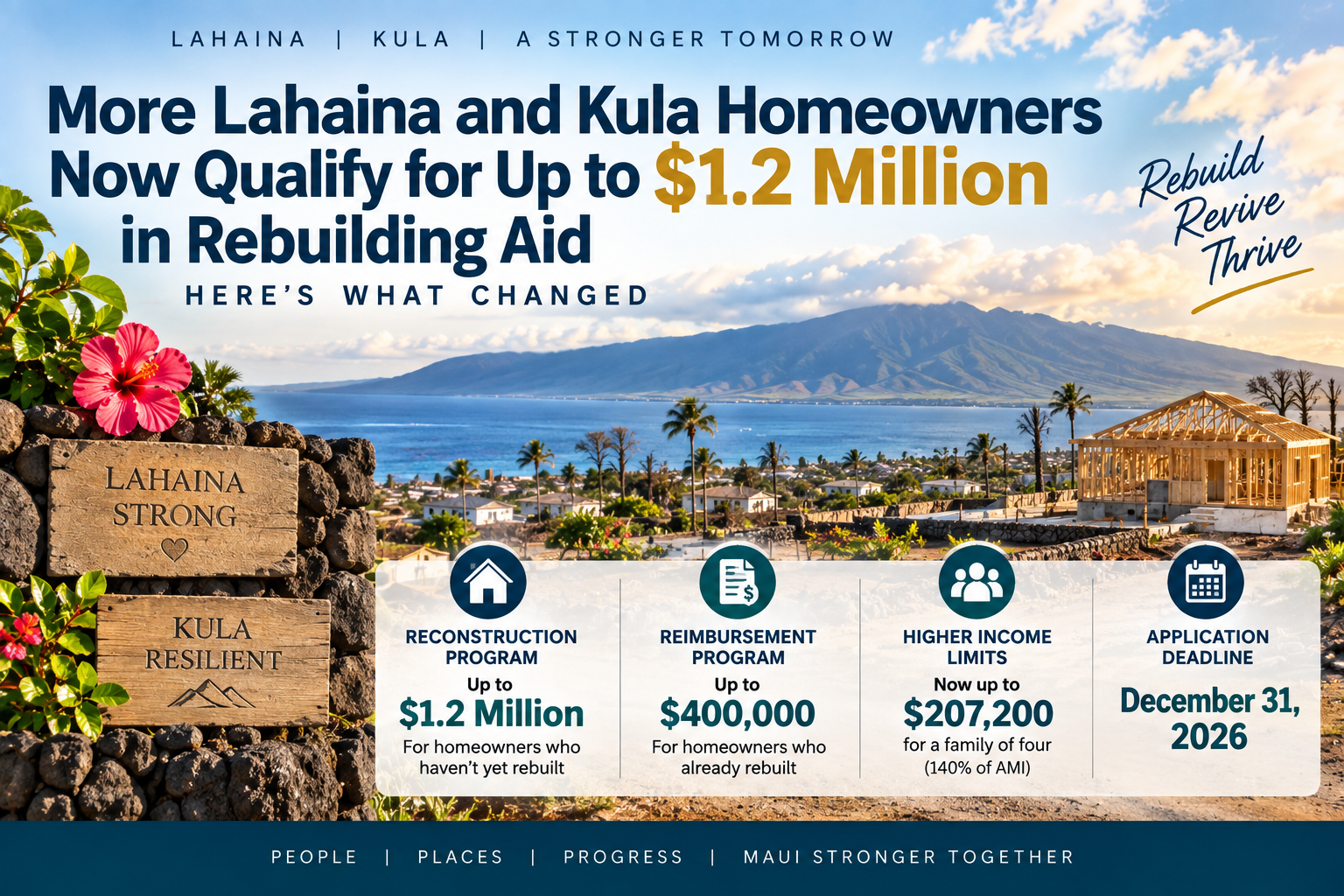
Quick Answer: More Lahaina and Kula homeowners affected by the 2023 Maui wildfires may now qualify for rebuilding assistance. Effective May 2026, HUD increased Maui County's Area Median Income from $110,000 to $121,400, raising the income limits for Maui County's Hoʻokumu Hou Reconstruction and Reimbursement Programs. Eligible homeowners can receive up to $1.2 million to rebuild a destroyed primary residence or up to $400,000 in reimbursement if they have already rebuilt. Applications are currently open through December 31, 2026.
For some Maui wildfire survivors, one of the biggest obstacles to rebuilding hasn't been debris removal or permitting.
It's been money.
Rebuilding a home in Lahaina or Kula can require an enormous amount of capital, and some homeowners previously found themselves in a difficult position: they earned too much to qualify for certain recovery assistance but nowhere near enough to comfortably finance an entire rebuild themselves.
That changed in 2026.
The U.S. Department of Housing and Urban Development increased Maui County's Area Median Income, or AMI, from $110,000 to $121,400 effective May 2026.
Because Maui County's Hoʻokumu Hou homeowner programs allow qualifying households to earn up to 140% of AMI, the change significantly increased the maximum household incomes allowed under the programs.
For homeowners who were previously told they earned too much to qualify, it may be worth checking again.
What Changed With Maui Wildfire Rebuilding Assistance in 2026?
The biggest change is the income limit.
Maui County's Hoʻokumu Hou Single-Family Homeowner Reconstruction and Reimbursement Programs are available to qualifying households earning up to 140% of Maui County's Area Median Income.
When HUD raised Maui County's base AMI in May 2026, the eligibility thresholds increased across every household size.
The new maximum income limits are:
| Household Size | Previous Limit | 2026 Limit |
|---|---|---|
| 1 person | $132,000 | $145,040 |
| 2 people | $150,780 | $165,760 |
| 3 people | $169,560 | $186,480 |
| 4 people | $188,340 | $207,200 |
| 5 people | $203,490 | $223,860 |
| 6 people | $218,540 | $240,380 |
| 7 people | $233,640 | $257,040 |
| 8 people | $248,780 | $273,560 |
Income eligibility is based on adjusted gross income.
For example, a four-person household can now have income of up to $207,200 and potentially qualify, compared with the previous limit of $188,340.
That is a meaningful difference for Maui households.
What Is Hoʻokumu Hou?
Hoʻokumu Hou is Maui County's wildfire recovery initiative funded through approximately $1.6 billion in Community Development Block Grant Disaster Recovery funds from HUD.
The program includes several housing and community recovery initiatives designed to address losses from the August 2023 Maui wildfires.
For individual homeowners, two of the most important programs are:
- The Single-Family Homeowner Reconstruction Program
- The Single-Family Homeowner Reimbursement Program
They serve different groups of homeowners.
Maui Single-Family Homeowner Reconstruction Program
The Hoʻokumu Hou Single-Family Homeowner Reconstruction Program is designed for qualifying homeowners whose primary residence was destroyed in the 2023 Maui wildfires and who still need to rebuild.
The maximum assistance available is:
Up to $1.2 million
To potentially qualify, you generally must have:
- Owned a home destroyed by the 2023 Maui wildfires
- Occupied that property as your primary residence at the time of the fire
- Household income at or below the applicable 140% AMI limit
- An unmet rebuilding need after accounting for other applicable disaster assistance
The final assistance amount isn't automatically $1.2 million.
The County determines assistance based on factors that include eligible rebuilding costs, program limitations, unmet need, and other disaster benefits already received, such as insurance, FEMA, or SBA assistance.
There's an Important Catch With the $1.2 Million Program
Homeowners considering the Reconstruction Program should understand that the assistance comes with long-term requirements.
According to Maui County, recipients must agree to occupy the rebuilt property and, if they sell during the applicable affordability period, sell it at an affordable price to an income-qualified buyer.
The length of that requirement depends on how much assistance is received:
| Reconstruction Assistance | Requirement Period |
| Up to $200,000 | 5 years |
| Up to $600,000 | 10 years |
| Up to $1.2 million | 25 years |
That's a potentially significant consideration.
Receiving substantial assistance may make rebuilding possible, but homeowners should also understand how accepting that money could affect their ability to sell the property later.
Anyone considering the program should review the current County documents carefully before committing.
Maui Single-Family Homeowner Reimbursement Program
The second program addresses a very different situation.
Some Lahaina and Kula homeowners didn't wait for public rebuilding assistance.
They used insurance proceeds, savings, loans, or other resources and rebuilt their homes themselves.
The Hoʻokumu Hou Single-Family Homeowner Reimbursement Program may provide qualifying homeowners with:
Up to $400,000 in reimbursement
The program is intended for eligible homeowners who:
- Lost their primary residence in the 2023 Maui wildfires
- Have already rebuilt
- Meet applicable income and program requirements
This program could be particularly important for homeowners who previously assumed they wouldn't qualify because their income exceeded the old limits.
With the 2026 income thresholds now higher, it's worth checking again.
When Is the Deadline to Apply?
The current application deadline for the Hoʻokumu Hou Single-Family Reconstruction and Reimbursement Programs is:
December 31, 2026
The County extended the application period after announcing the new income limits.
Homeowners who previously explored the program but didn't qualify should not assume the earlier determination still applies.
Your eligibility may have changed.
Can Lahaina Homeowners Get $1.2 Million to Rebuild?
Potentially, yes.
An eligible Lahaina homeowner whose primary residence was destroyed in the August 2023 wildfire may qualify for up to $1.2 million through the Single-Family Homeowner Reconstruction Program.
However, $1.2 million is the maximum, not a guaranteed grant amount.
Eligibility and assistance depend on the homeowner's income, eligible rebuilding costs, unmet need, previous disaster assistance, insurance proceeds, and other program requirements.
Can Kula Wildfire Homeowners Qualify Too?
Yes.
Although most attention surrounding the 2023 Maui wildfires has understandably focused on Lahaina, eligible homeowners whose primary residences were destroyed in the Kula wildfire can also potentially qualify.
The Kula rebuilding numbers are much smaller because substantially fewer homes were destroyed there.
As of August 7, 2026, Maui County reported that of the 21 Kula homes destroyed, five had been rebuilt and 11 additional building permits had been issued.
So the recovery situation in Kula looks very different numerically from Lahaina, but the rebuilding programs are relevant to qualifying Upcountry wildfire survivors as well.
How Much of Lahaina Has Been Rebuilt?
The recovery is now much further along than it was during the first two years after the fires.
As of August 7, 2026, Maui County reported:
- Nearly 600 homes rebuilt and occupied
- Approximately 400 additional homes under construction
- About 1,264 additional housing-unit permits issued or being processed
- 2,248 of the 2,746 housing units lost, or approximately 81.9%, somewhere on the path toward rebuilding
Those figures include homes that are completed, under construction, permitted, or moving through the permitting process.
That doesn't mean 82% of Lahaina has physically been rebuilt.
It means approximately 82% of the housing units lost in the Maui wildfires are now somewhere along the rebuilding pipeline.
That's an important distinction.
What Infrastructure Has Been Restored in Lahaina?
Several major infrastructure milestones have also been reached.
As of August 2026:
- The final Lahaina unsafe-water advisory had been lifted
- Sewer service had been fully restored
- Wildfire debris removal had been completed
- All Lahaina roads had reopened
- Front Street reopened to vehicle traffic on August 1, 2026
Commercial rebuilding is also progressing.
The County reported that commercial properties within the historic Front Street district are moving through various stages of planning and permitting, while the ʻUlu o Lele Marketplace is expected to help bring additional commercial activity back to Front Street.
For anyone who hasn't been through Lahaina recently, the recovery is becoming increasingly visible.
But there is still a tremendous amount of rebuilding left to do.
Can You Buy a Lahaina Fire Lot and Get the $1.2 Million Rebuilding Grant?
This is particularly important for real estate buyers.
Don't assume that buying a fire-affected lot gives you access to the previous owner's Hoʻokumu Hou rebuilding assistance.
The Single-Family Homeowner Reconstruction Program is designed for homeowners who owned and occupied the destroyed home as their primary residence at the time of the 2023 Maui wildfires.
A new purchaser generally wouldn't satisfy that requirement simply by buying the vacant property later.
So if you're considering purchasing a vacant Lahaina or Kula fire lot, the purchase should make financial sense based on your own:
- Land acquisition cost
- Architectural and engineering expenses
- Construction budget
- Financing
- Permitting
- Utility connections
- Site conditions
- Insurance
- Timeline
- Intended use
Don't underwrite the purchase assuming that $1.2 million in County rebuilding assistance transfers with the property.
What Does the Expanded Rebuilding Aid Mean for Lahaina Real Estate?
There could be several real estate implications.
Some owners who had considered selling because rebuilding wasn't financially realistic may now have another option.
An owner who previously exceeded the income limit may suddenly qualify for hundreds of thousands of dollars in additional rebuilding assistance.
That could affect the owner's decision to:
- Rebuild
- Hold the property
- Sell the lot
- Sell after rebuilding
- Use insurance proceeds differently
At the same time, the affordability and resale requirements attached to the Reconstruction Program mean homeowners should carefully understand the long-term implications before accepting assistance.
This isn't simply free money with no conditions.
What Should Lahaina and Kula Homeowners Do Now?
If you lost your primary residence in the 2023 Maui wildfires and previously thought you didn't qualify for rebuilding assistance, I would revisit the numbers.
In particular, check:
- Your current household size
- Adjusted gross income
- Insurance proceeds already received
- FEMA or SBA assistance
- Rebuilding expenses
- Whether construction has already started or finished
- Whether the Reconstruction or Reimbursement Program better fits your situation
You can apply through the Maui County Office of Recovery and Hoʻokumu Hou program.
The County also has case managers available to help homeowners determine eligibility and navigate the required documentation.
Frequently Asked Questions About Maui Wildfire Rebuilding Aid
How much money can Lahaina homeowners receive to rebuild?
Eligible homeowners can potentially receive up to $1.2 million through Maui County's Hoʻokumu Hou Single-Family Homeowner Reconstruction Program. The actual amount depends on eligible costs, unmet need, previous disaster benefits, and program requirements.
What is the income limit for Maui wildfire rebuilding assistance in 2026?
Eligibility extends up to 140% of Maui County Area Median Income. In 2026, that ranges from $145,040 for a one-person household to $273,560 for an eight-person household.
What is the income limit for a family of four?
A four-person household can have adjusted gross income of up to $207,200 under the 2026 limit.
Can I qualify if I already rebuilt my Lahaina home?
Potentially. The Single-Family Homeowner Reimbursement Program provides qualifying homeowners who have already rebuilt with up to $400,000 in reimbursement.
Can Kula homeowners qualify for Maui wildfire rebuilding assistance?
Yes. The programs apply to eligible homeowners affected by the 2023 Maui wildfires, including qualifying homeowners whose primary residences were destroyed in Kula.
Do I automatically receive $1.2 million if I qualify?
No. $1.2 million is the program maximum. Actual assistance depends on eligible rebuilding costs, unmet need, duplication-of-benefits requirements, and other program rules.
Can I receive assistance if I already received insurance or FEMA money?
Possibly. Receiving insurance, FEMA, SBA, or other disaster assistance doesn't necessarily disqualify you, but those funds can affect the calculation of your unmet need and the amount of assistance available.
Can someone buying a Lahaina fire lot qualify for the rebuilding program?
A buyer shouldn't assume so. The Reconstruction Program generally requires the applicant to have owned and occupied the destroyed property as their primary residence when the 2023 wildfire occurred. Eligibility should be verified directly with Maui County before relying on any rebuilding assistance when evaluating a property purchase.
Are there restrictions if I accept the rebuilding assistance?
Yes. Reconstruction assistance carries occupancy and affordability requirements. Depending on the amount received, those restrictions can apply for 5, 10, or 25 years.
When is the deadline for Maui wildfire rebuilding assistance?
The current application deadline for the Single-Family Homeowner Reconstruction and Reimbursement Programs is December 31, 2026.
Buying, Selling, or Rebuilding Property in Lahaina or Kula?
Three years after the Maui wildfires, the real estate picture in Lahaina and Kula continues to evolve.
Homes are being rebuilt.
Infrastructure has reopened.
More permits are moving through the system.
And now, substantially more homeowners may qualify for financial assistance than they did just a few months ago.
For existing wildfire survivors, the new income limits may change the financial feasibility of rebuilding.
For buyers, the story is different.
A fire-affected lot can represent an opportunity, but the economics need to be evaluated based on the actual property, construction costs, permitting, financing, and intended use rather than assuming government rebuilding assistance will transfer with the sale.
If you're considering rebuilding, selling a fire-affected property, or buying land in Lahaina or Kula, I'm happy to help you look at the real estate side of the equation and understand what's happening in that specific neighborhood.
Benjamin Finnerty REALTOR® RS-83812
Keller Williams Realty Maui RB-21851
808-481-9748
Benjamin@the808team.com
www.the808team.com
This article is provided for general real estate information only and is not legal, financial, tax, or eligibility advice. Hoʻokumu Hou requirements and funding are administered by Maui County and may change. Homeowners should verify their eligibility, assistance amount, affordability restrictions, application requirements, and deadlines directly with the County of Maui Office of Recovery before making financial or real estate decisions.

The 808 Team Maui
| The 808 Team | Keller Williams Realty Maui
or another way