

Categories
InsurancePublished September 11, 2026
Before You Buy on Maui: What Hawaii’s Insurance Market Shake-Up Means for Your Bottom Line

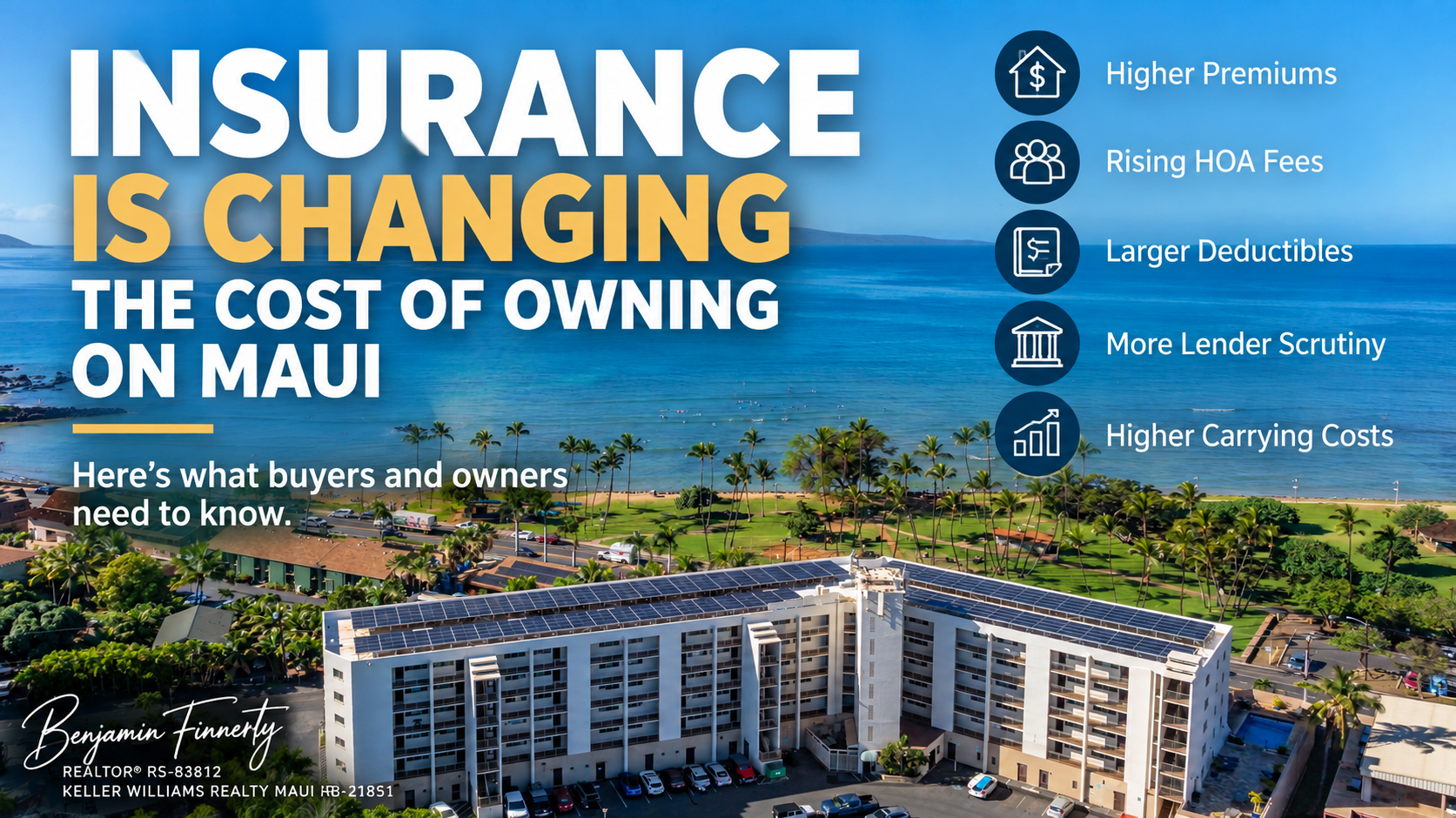
Before You Buy on Maui: What Hawaii’s Insurance Market Shake-Up Means for Your Bottom Line
If you’ve been watching Maui listings and doing the math on a purchase, there’s one number that deserves more attention than it used to:
Insurance.
Hawaii’s property insurance market has changed substantially over the past several years, and the effects are showing up in premiums, underwriting requirements, condominium HOA expenses, and even whether certain properties can be financed.
That doesn’t mean insurance is unavailable on Maui.
Buyers are still getting policies and closing transactions every month.
But the process requires more homework than it did a few years ago, and waiting until just before closing to investigate insurance can create an expensive surprise.
Quick Answer: Maui buyers in 2026 should investigate homeowners, hurricane, flood, and condominium master-policy insurance early in the purchase process. Some insurers have exited Hawaii, underwriting has tightened on certain property types, and condominium associations have faced particularly difficult hurricane-insurance costs. Hawaii has created and reactivated insurance backstops, including HPIA for individual residential properties and the Hawaii Hurricane Relief Fund for qualifying condominium associations, but buyers should treat those as parts of the insurance landscape rather than substitutes for careful due diligence.
Why Hawaii’s Property Insurance Market Changed
There isn’t one single reason insurance has become more complicated in Hawaii.
Several forces have converged.
The August 2023 Maui wildfires dramatically increased attention on catastrophe risk in Hawaii.
At the same time, insurers nationally have been dealing with higher rebuilding costs, increased reinsurance expenses, severe-weather losses, and rapidly changing assessments of wildfire, hurricane, and other natural-hazard risk.
Hawaii also has unusually high replacement costs.
Building materials often need to be shipped to the islands, labor costs are high, and construction timelines can be longer than they are in many mainland markets.
All of that influences what it costs an insurer to rebuild a damaged property.
Some Insurance Companies Have Left Hawaii
The changing market isn’t theoretical.
Insurance carriers have actually withdrawn.
In October 2025, DTRIC announced that it would transition into run-off status in Hawaii.
That means DTRIC stopped writing new policies and renewing existing ones while continuing to manage existing claims and meet its obligations on active policies.
Hawaii Insurance Commissioner Scott Saiki advised affected consumers to begin searching for replacement coverage early and to make sure they work with licensed insurance professionals.
DTRIC wasn’t the first carrier to leave.
Universal Property & Casualty had previously announced its withdrawal from Hawaii’s homeowners, condominium, and renters insurance market.
The practical lesson for buyers is simple:
Don’t assume every insurer writes every Maui property.
Availability can depend on location, construction type, age, roof condition, wildfire exposure, hurricane risk, and the characteristics of the particular home or condominium complex.
Insurance Is Still Available
This distinction matters.
A difficult insurance market is not the same thing as an uninsurable market.
Hawaii still has private-market insurers writing homeowners and hurricane coverage.
The Hawaii Insurance Division also publishes sample premium comparisons to help consumers evaluate companies.
But buyers should expect insurers to look closely at the property.
For an older Maui home, questions may include:
- Construction type
- Roof age and condition
- Electrical systems
- Plumbing
- Prior claims
- Wildfire exposure
- Wind-mitigation features
- Distance from the coast
- Replacement cost
Two homes with similar market values can receive very different insurance quotes.
Homeowners Insurance and Hurricane Insurance Are Not Necessarily the Same Thing
This is one of the biggest differences mainland buyers need to understand.
Hawaii’s Insurance Division specifically warns consumers that many standard homeowners and renters policies do not include hurricane or flood coverage.
Depending on the carrier and policy structure, you may need separate hurricane coverage.
Flood insurance is another separate issue.
A property near the ocean, stream, drainage area, or FEMA-designated flood zone may require additional investigation and potentially separate flood insurance.
So when you ask:
“How much is the insurance?”
You may actually need answers to several questions:
- What does the homeowners policy cover?
- Is hurricane coverage included or separate?
- Is flood coverage required or recommended?
- What are the deductibles?
- What is the replacement-cost limit?
- Are there exclusions that matter for this property?
Hurricane Deductibles Can Be Much Larger Than Buyers Expect
Hurricane insurance often works differently from the flat-dollar deductible many buyers are used to.
The Hawaii Insurance Division’s own sample hurricane-policy comparisons commonly use a 2% deductible.
That percentage is generally tied to the insured value rather than the size of the loss.
For example, if the applicable insured value were $700,000:
2% = $14,000
That means the homeowner could potentially be responsible for $14,000 before hurricane coverage begins paying on a qualifying loss.
The exact deductible varies by policy, so buyers should ask their insurance broker to translate the percentage into an actual dollar amount.
Don’t just ask:
“What’s my deductible?”
Ask:
“What would I actually have to pay out of pocket on this specific property?”
What Happens if a Maui Home Can’t Get Standard Insurance?
Hawaii has a residential insurance backstop called the Hawaii Property Insurance Association, or HPIA.
HPIA provides basic property coverage for eligible properties that cannot obtain coverage through the voluntary private market.
It is essentially an insurer of last resort.
HPIA currently offers policy limits ranging from $50,000 to $450,000.
That is an important limitation on Maui.
The rebuilding cost of many Maui homes can substantially exceed $450,000.
HPIA itself states that its coverage is generally more expensive and less comprehensive than coverage available through the voluntary market.
So HPIA is a genuine safety net.
But it should not be treated as an automatic solution for every high-value Maui home.
Maui Condo Buyers Face a Different Insurance Problem
If you’re buying a Maui condominium, the insurance analysis becomes more complicated.
You typically need to think about two different layers of insurance.
First, the condominium association carries a master insurance policy covering the building and common elements.
Second, the individual condo owner generally carries their own unit-owner policy, commonly called an HO-6 policy, covering things such as personal property, liability, and certain interior improvements.
The master policy is paid for through the AOAO.
When the association’s insurance costs increase, owners ultimately pay for it.
That may happen through:
- Higher monthly HOA dues
- Increased operating budgets
- Special assessments
- Reduced spending elsewhere
- Higher reserve contributions
This is one reason Maui condo HOA fees have become such an important part of the buying decision.
Condo Insurance Can Also Affect Financing
Insurance isn’t merely an operating expense.
It can determine whether a lender will finance the unit.
Fannie Mae and Freddie Mac generally require condominium projects to maintain appropriate master insurance coverage.
If the association is significantly underinsured, lenders may have difficulty selling mortgages into the secondary market.
Hawaii’s Insurance Division has specifically warned that inadequate master-policy coverage can affect mortgage availability and potentially limit a condo building to a smaller pool of buyers.
That makes the association’s insurance documents part of your financing due diligence, not just HOA paperwork.
Hawaii Reactivated the Hurricane Relief Fund for Condos
The condominium insurance problem became serious enough that Hawaii reactivated the Hawaii Hurricane Relief Fund, or HHRF.
The current HHRF program provides hurricane-only commercial property insurance to qualifying condominium and townhouse associations.
It does not insure individual condo units.
Instead, it helps associations obtain hurricane master-policy coverage when sufficient coverage isn’t reasonably available through the private market.
To potentially qualify, an AOAO generally must:
- Have been denied hurricane coverage by at least two Hawaii-licensed insurers
- Have buildings with a total insured value above $10 million
The HHRF can provide up to $140 million of excess hurricane coverage, subject to program requirements, and uses a mandatory 2% per-building deductible.
The state has reported that some condominium associations obtaining coverage through the program have seen substantial reductions in hurricane-insurance costs compared with previous options.
That is an encouraging development for Hawaii condos.
But buyers still need to evaluate each association separately.
What Should You Review Before Buying a Maui Condo?
If you’re considering a condo, I would want to see more than the monthly HOA fee.
Ask for:
- The current master insurance declaration page
- The association’s hurricane coverage
- Total insured value
- Deductibles
- Current insurance premium
- Previous year’s premium
- Reserve study
- Current operating budget
- Recent board meeting minutes
- Special assessment information
- Pending insurance renewals
- Any discussions about coverage reductions
- Any financing issues connected to insurance
The board minutes can be particularly revealing.
If the association has spent the past six months discussing an upcoming $500,000 insurance increase or a potential special assessment, that matters to you as a buyer.
My guide to Maui condo HOA fees explains why comparing HOA dues without looking at what those dues actually cover can be misleading.
If you’re financing the purchase, my guide to Maui condo financing in 2026 goes deeper into how insurance, reserves, and project eligibility can affect lending.
What Should You Review Before Buying a Maui Home?
For a single-family home, insurance due diligence is generally more property-specific.
I recommend getting an insurance quote during your inspection or due-diligence period.
Give the insurance broker as much information as possible about:
- Address
- Construction type
- Year built
- Roof age
- Square footage
- Renovations
- Electrical upgrades
- Plumbing upgrades
- Solar
- Pools
- Detached structures
- Prior insurance claims
For older Maui homes, construction type can be particularly important.
Hawaii’s insurance comparison data shows meaningful premium differences between single-wall wood, double-wall wood, and masonry construction.
That doesn’t automatically make an older single-wall home a bad purchase.
It means the insurance cost needs to be known before you commit.
Get More Than One Insurance Quote
This is one of the easiest ways buyers can protect themselves.
Different insurance companies can price the exact same property very differently.
One carrier may decline it.
Another may quote it at a high premium.
A third may consider it completely ordinary.
So whenever possible, get multiple quotes.
And don’t compare premiums alone.
Compare:
- Coverage limits
- Hurricane coverage
- Deductibles
- Replacement-cost provisions
- Loss-of-use coverage
- Liability coverage
- Exclusions
The cheapest policy isn’t necessarily the best policy.
Don’t Wait Until Closing
This may be the most important takeaway.
Historically, some buyers treated homeowners insurance as something the lender handled near the end of escrow.
I wouldn’t recommend that approach today.
Insurance should be investigated early enough that you still have options if the quote comes back dramatically higher than expected.
For example, imagine you've budgeted $3,000 annually for insurance.
You go under contract.
Then two weeks before closing, you discover the actual combination of homeowners and hurricane insurance will cost $8,000.
Your monthly ownership cost just changed substantially.
Finding that out during your due-diligence period gives you far more flexibility than discovering it after every other contingency has expired.
What Does Maui Home Insurance Cost in 2026?
There isn't one useful Maui-wide number.
Premiums depend heavily on the specific property.
A newer concrete home in one part of Maui may have a completely different risk profile from:
- An older single-wall home
- An oceanfront residence
- A Kula acreage property
- A Lahaina rebuild
- A Wailea luxury home
That's why online averages are less useful than an actual quote tied to the address you're considering.
The same principle applies to condos.
The association's insurance expense can vary dramatically between buildings.
Is Property Insurance Making Maui Real Estate Unaffordable?
For some buyers, insurance absolutely affects affordability.
But insurance shouldn't be viewed in isolation.
The real ownership cost includes:
- Mortgage payment
- Property taxes
- Homeowners insurance
- Hurricane insurance
- Flood insurance, if applicable
- HOA dues
- Special assessments
- Utilities
- Maintenance
- Repairs
A property with a slightly higher purchase price but lower HOA and insurance expenses can sometimes cost less to own than the supposedly cheaper alternative.
That’s why I encourage buyers to compare the complete monthly carrying cost, not simply the purchase price.
Frequently Asked Questions About Maui Property Insurance
Is homeowners insurance available on Maui?
Yes. Private insurers continue to write homeowners insurance in Hawaii, although eligibility and pricing vary by property, carrier, construction type, location, and risk profile.
Do Maui homeowners need separate hurricane insurance?
Sometimes. Hawaii’s Insurance Division warns that many standard homeowners policies do not cover hurricane damage, so buyers should confirm whether hurricane coverage is included or requires a separate policy.
Is flood insurance included in homeowners insurance?
Generally not. Flood coverage is usually separate and should be evaluated based on the property’s location and flood risk.
What is HPIA?
The Hawaii Property Insurance Association is an insurer of last resort for eligible residential properties that cannot obtain coverage through the standard private insurance market.
How much coverage does HPIA offer?
HPIA currently offers policy limits ranging from $50,000 to $450,000.
Is HPIA cheaper than regular insurance?
Usually not. HPIA states that its policies are generally more expensive and provide less coverage than many voluntary-market policies.
Why are Maui condo insurance costs important?
The condominium association pays for the building’s master policy. Higher insurance costs can therefore result in higher HOA dues, assessments, or financing complications for individual owners.
What is the Hawaii Hurricane Relief Fund?
The Hawaii Hurricane Relief Fund currently provides excess hurricane master-policy coverage to eligible condominium and townhouse associations that have difficulty obtaining sufficient hurricane insurance through the private market.
Can condo insurance affect my mortgage?
Yes. Insufficient master insurance coverage can affect whether certain lenders or secondary mortgage-market programs will finance units in a condominium project.
When should I get an insurance quote when buying on Maui?
As early as reasonably possible during the purchase process, ideally while you still have applicable due-diligence protections.
The Bottom Line
Maui’s insurance market has changed.
That doesn't mean buyers should panic.
It means insurance needs to move higher on the due-diligence checklist.
For a single-family home, get actual homeowners and hurricane quotes early.
For a condo, investigate both your individual coverage and the association’s master insurance.
And in either case, understand the deductibles and actual replacement-cost coverage rather than focusing only on the annual premium.
The best time to discover an insurance issue is before you become obligated to buy the property.
If you’re considering a Maui home or condo and want help understanding what insurance, HOA expenses, financing, and other ownership costs could look like for a specific property, reach out anytime.
I’m happy to help you look at the full cost of ownership and connect you with Hawaii insurance professionals who can provide property-specific quotes and advice.
Benjamin Finnerty REALTOR® RS-83812
Keller Williams Realty Maui RB-21851
808-481-9748
Benjamin@the808team.com
www.the808team.com
This article is provided for general real estate information only and is not insurance, financial, legal, or tax advice. Insurance availability, premiums, deductibles, coverage, and underwriting requirements vary by property and insurer and may change. Buyers should verify property-specific insurance information directly with a Hawaii-licensed insurance professional before making a real estate decision.

The 808 Team Maui
| The 808 Team | Keller Williams Realty Maui
or another way