
Categories
Maui Vacation RentalsPublished August 31, 2026
Maui Vacation Rental Investment Outlook 2026: Are Hotel-Zoned Condos Set Up for a Comeback?

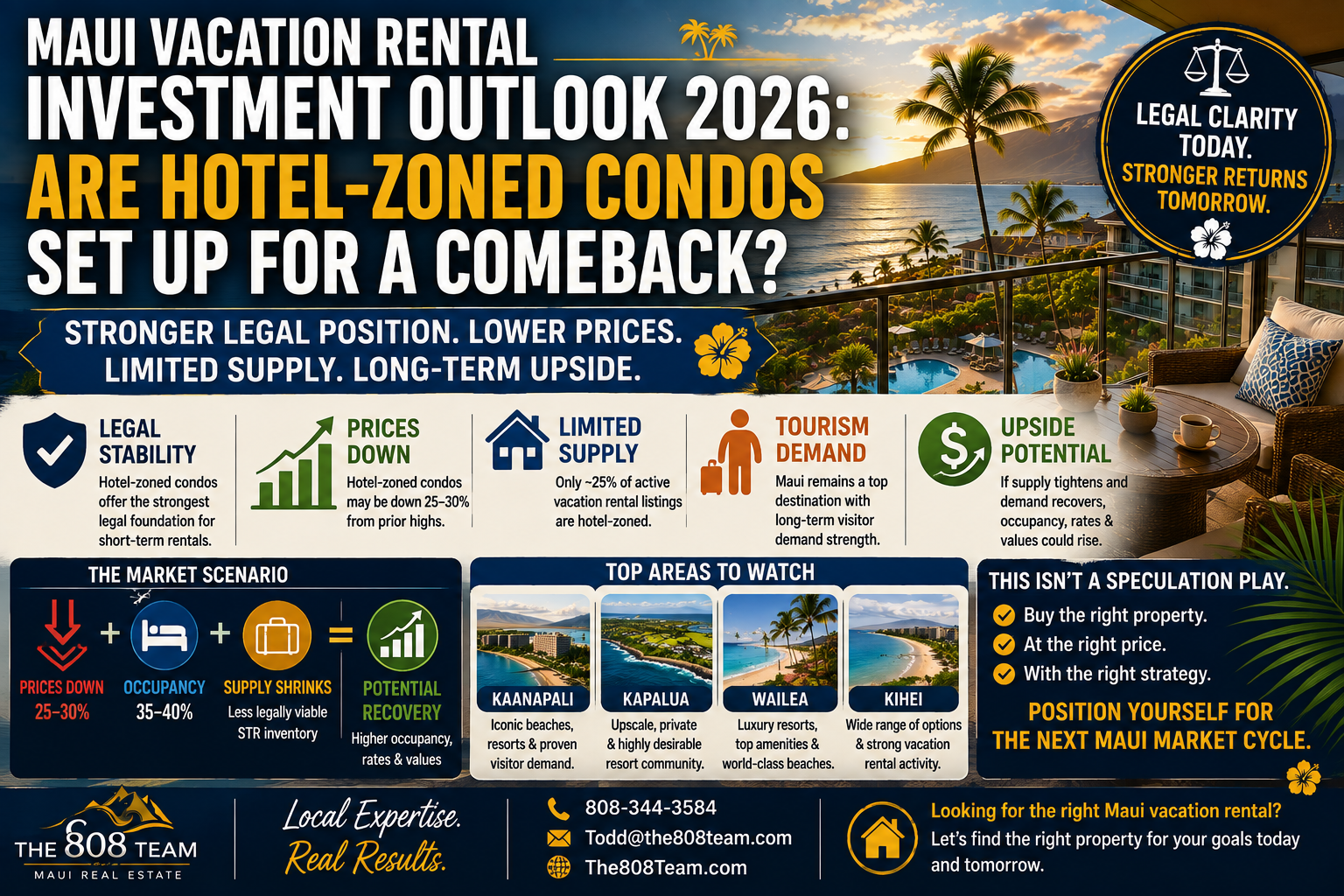
Maui Vacation Rental Investment Outlook 2026: Are Hotel-Zoned Condos Set Up for a Comeback?
Maui's vacation-rental market looks challenging on the surface right now.
And that may be exactly why investors should be paying attention.
Prices have pulled back from previous highs. Rental performance has softened. Inventory has increased in parts of the condo market. And regulatory uncertainty surrounding short-term rentals has caused some buyers to simply sit on the sidelines.
But underneath those headlines, I think something very interesting may be developing.
Hotel-zoned Maui vacation rentals are entering this period with something many competing properties don't have: a much clearer foundation for long-term visitor use.
If Maui tourism strengthens over the next several years while the number of legally viable vacation rentals becomes more constrained, today's weakness could eventually create tomorrow's opportunity.
So I don't think the most important question is:
"How are Maui vacation rentals performing today?"
The better question may be:
"What could this market look like two, three, or five years from now?"
Key Takeaways
- Hotel-zoned Maui condos generally provide a stronger legal foundation for short-term-rental use.
- Maui vacation-rental prices have pulled back from previous highs, creating lower entry points in some resort markets.
- Today's weaker occupancy and nightly rates shouldn't automatically be treated as permanent.
- If Maui tourism strengthens while legal STR inventory contracts, remaining permitted properties could benefit.
- Kaanapali, Kapalua, Wailea and select parts of Kihei remain some of the resort markets I'd watch most closely.
- The opportunity isn't about perfectly calling the bottom. It's about buying a quality asset at a price that works under several future scenarios.
Why Hotel Zoning Matters More Than Ever
If you're buying a Maui vacation rental, zoning should be one of the first things you investigate.
Not the countertops.
Not the furniture package.
Not even the projected rental income.
Zoning.
A hotel-zoned property is located in an area where visitor accommodation is generally an intended use. That provides a very different investment foundation than buying a property whose future short-term-rental use faces greater regulatory uncertainty.
That's why I've been paying so much attention to this segment.
If you want the deeper explanation of why I currently favor these properties, read my The Best Maui Vacation Rental to Buy Right Now? Why Hotel-Zoned Condos Stand Out guide.
The basic idea is simple:
I don't want my entire investment thesis to depend on winning a future regulatory battle if I don't have to.
Maui's Market Reset Is Creating a Different Entry Point
The Maui condo market isn't where it was at the peak.
That's obvious.
Buyers aren't chasing properties the way they once were. Rental performance has softened. Higher carrying costs, HOA fees, insurance concerns and regulatory uncertainty have all affected buyer sentiment.
But corrections create something investors didn't have during the hottest part of the market:
Negotiating power and lower entry prices.
Hotel-zoned properties haven't escaped the correction.
But that's actually part of what makes the opportunity interesting.
You're potentially getting an asset with a stronger legal-use foundation without having to pay peak-market pricing for it.
For a broader look at which parts of Maui real estate are holding up and which have experienced larger corrections, read my Maui Real Estate Market Update 2026.
Don't Make the Mistake of Assuming All Maui Condos Are the Same
This is one of the biggest mistakes I see investors make.
Two Maui condos can look nearly identical.
Both can be near the beach.
Both can have pools.
Both may historically have hosted vacationers.
Both can appear to offer attractive rental income.
But legally, financially and from an investment standpoint, they can be completely different assets.
One may have hotel zoning and a relatively straightforward visitor-use story.
Another may be apartment-zoned and facing significantly more uncertainty.
That doesn't necessarily make the apartment-zoned property a bad investment.
In fact, the deeper discounts in that market could potentially create much larger upside for the right buyer.
But it's a different investment thesis.
I've covered that side of the market in Are Maui Apartment-Zoned Condos Undervalued? The Zoning Opportunity Investors Are Watching.
Think about the difference this way:
Hotel-zoned strategy: Greater legal clarity + corrected pricing + tourism recovery potential.
Apartment-zoned strategy: Greater regulatory uncertainty + potentially much deeper discount + potentially larger upside.
Neither strategy is automatically right.
The important thing is knowing which game you're playing before you buy.
The Supply Side May Be the Most Important Part of This Story
Most buyers look at current rental numbers.
I think investors should also be looking at future supply.
Suppose Maui's legally viable short-term-rental inventory becomes smaller over the next several years.
Now combine that with a recovery in visitor demand.
You potentially have:
Fewer legal vacation rentals
More visitors competing for those rentals
=
A potentially stronger operating environment for the remaining legally permitted properties.
That's the part of the investment thesis I find particularly interesting.
It doesn't require Maui tourism to explode.
It simply requires demand to improve while available legal supply becomes tighter.
Scenario 1: Tourism Remains Soft and Supply Stays High
We should start with the scenario nobody wants.
Tourism remains sluggish.
Occupancy stays under pressure.
Nightly rates remain competitive.
Vacation-rental supply stays relatively high.
Under this scenario, hotel-zoned properties could continue facing pressure.
That's why I wouldn't buy a Maui vacation rental today using aggressive assumptions.
The deal needs to survive a slower recovery.
Scenario 2: Tourism Recovers but Supply Remains Similar
Now suppose visitor demand strengthens.
More travelers return.
Occupancy improves.
Nightly rates begin moving higher.
But the overall number of available vacation rentals doesn't change dramatically.
Quality hotel-zoned properties should still benefit because they're positioned in established resort markets with proven visitor demand.
That's a good outcome.
But there's potentially an even more interesting one.
Scenario 3: Tourism Recovers While Legal STR Supply Shrinks
This is the scenario that gets my attention.
Imagine visitor demand returning while a meaningful amount of competing short-term-rental inventory is no longer available in the same way.
Now the remaining legally permitted properties aren't simply participating in a Maui tourism recovery.
They're participating in that recovery with less competition.
That could potentially affect:
- Occupancy
- Average nightly rates
- Annual rental revenue
- Buyer demand
- Property values
None of those outcomes are guaranteed.
But this is exactly why I'm looking beyond today's rental numbers.
The source draft's investment thesis rests on this same combination of stronger legal positioning, lower entry pricing, weaker current rental performance and the possibility of reduced future competition.
Maui Tourism Doesn't Need to Recover Overnight
I wouldn't buy one of these properties expecting everything to snap back next year.
That's speculation.
I'd rather ask:
Where could Maui tourism be in three years?
Where could it be in five years?
Maui remains one of the world's best-known island destinations.
Economic cycles happen.
Travel slows.
Consumer confidence changes.
Natural disasters affect tourism.
But the fundamental things that have attracted visitors to Maui for generations haven't disappeared.
The beaches are still here.
The weather is still here.
The ocean is still here.
The resort infrastructure is still here.
And Maui remains a destination people around the world want to experience.
That's why I'd evaluate a Maui vacation-rental investment on a multi-year horizon rather than based entirely on the next quarter.
The Regulatory Situation Could Create Winners and Losers
This is another reason property selection matters so much.
I don't believe every Maui vacation rental will emerge from the current regulatory environment in the same position.
Properties with clear visitor-oriented zoning may ultimately become more valuable precisely because that clarity becomes harder to find.
Other properties may face greater uncertainty.
That's why owners and investors shouldn't simply react to every headline.
I go deeper into that strategy in my Maui Vacation Rentals: The Real Risk Isn't the Rule Change—It's What You Do Next article.
And if you want the broader regulatory background, read my Maui Bill 9: What Vacation Rental Owners Should Do Now and Bill 9, Bill 88 and the Maui Condo Market guides.
The goal isn't to predict every future government decision.
It's to own an asset that gives you multiple ways to win.
Where I'd Look First
If I'm evaluating hotel-zoned Maui vacation-rental opportunities, established visitor markets are where I'd start.
Kaanapali
Kaanapali remains one of Maui's most recognizable resort destinations.
It has beaches, golf, restaurants, shopping, major resorts and decades of visitor recognition.
That matters because you're not trying to create demand from scratch.
Kapalua
Kapalua operates at the higher end of the market.
The buyer pool and rental economics can be different, but limited inventory, strong resort recognition and luxury positioning make the right properties interesting long-term assets.
Wailea
Wailea remains one of Maui's premier luxury resort communities.
Its beaches, resorts, restaurants, golf and high-end reputation give it a powerful foundation for visitor demand.
Kihei
Kihei offers a broader range of price points.
But this is where you really need to understand zoning because neighboring condo complexes can have dramatically different legal-use situations.
For buyers researching South Maui, my 5 Hotel-Zoned Condo Complexes in Kihei Every Maui Buyer Should Know About is a good place to start.
You can also dig deeper into individual properties with my Kihei Akahi Condos for Sale and Mana Kai Maui Condos for Sale guides.
The HOA Can Make or Break the Investment
Hotel zoning doesn't automatically make a condo a good investment.
You still have to investigate the association.
I want to understand:
- HOA dues
- Reserve funding
- Master insurance
- Special assessments
- Upcoming capital projects
- Litigation
- Rental restrictions
- Management
- Maintenance history
- Building condition
A great unit in a financially troubled association can become a terrible investment.
That's why I recommend reading my The Hidden Costs of Owning a Condo on Maui in 2026 before analyzing the cash flow on any Maui condo.
Don't Underwrite Using Peak-Era Rental Numbers
This is critical.
If a property had an incredible rental year during the peak, don't assume that's your future.
And don't take the listing agent's gross rental number and call it cash flow.
Start with realistic assumptions.
Look at:
- Current occupancy
- Realistic nightly rates
- Seasonality
- Property management
- HOA dues
- Taxes
- Insurance
- Utilities
- Repairs
- Maintenance
- Furnishings
- Booking costs
- Financing
- Reserves
Then stress-test it.
What happens if Maui takes three years to recover instead of one?
What happens if HOA dues increase?
What happens if insurance increases?
What happens if nightly rates remain soft?
And then:
What happens if tourism improves and competing legal inventory decreases?
That's how I want to evaluate the opportunity.
If you're thinking about buying any Maui condo as an investment, my Thinking About a Maui Condo Investment? Start With These 5 Questions article goes deeper into that underwriting process.
The Investment Should Work Without a Perfect Recovery
This may be the most important rule in the entire article.
Don't buy something that requires everything to go right.
If you need occupancy to immediately return to historical highs...
If you need nightly rates to jump...
If you need interest rates to fall...
If you need HOA fees to stay flat...
If you need massive appreciation...
Then you don't have much margin for error.
I'd rather buy a quality property at a price where I can afford to be patient.
If the recovery happens faster?
Great.
If it takes longer?
I still own an asset I want to own.
Who This Strategy Makes Sense For
Hotel-zoned Maui condos may be particularly interesting for buyers who want:
- A vacation rental with stronger legal footing
- A Maui second home with rental potential
- A longer holding period
- Exposure to a future Maui tourism recovery
- A property in an established resort area
- Lower regulatory uncertainty than more speculative alternatives
- Personal use combined with investment potential
For mainland buyers considering this strategy, my Buying Property in Hawaii From the Mainland: What You Need to Know in 2026 article covers financing, taxes, ownership structure and buying remotely.
Frequently Asked Questions
Are hotel-zoned condos the safest Maui vacation-rental investment?
From a legal-use perspective, I believe they generally provide one of the stronger foundations for buyers who want to operate a short-term rental. That doesn't eliminate market, HOA, insurance, financing or operational risk.
Is the Maui vacation-rental market recovering?
The market is still working through softer pricing and rental conditions. Rather than trying to call an exact recovery date, I'm watching visitor demand, occupancy, nightly rates, inventory and the regulatory environment.
Why could hotel-zoned condos outperform?
If visitor demand strengthens while the supply of legally viable vacation rentals tightens, properties with clearer visitor-use rights could potentially benefit from stronger occupancy, rates and buyer demand.
Is now a good time to buy a Maui vacation rental?
It can be for the right buyer and the right property. I wouldn't try to perfectly time the bottom. I'd focus on buying a quality asset at a price that works using conservative assumptions.
Should I buy hotel-zoned or apartment-zoned?
It depends on your risk tolerance. Hotel-zoned properties generally provide greater legal clarity. Certain apartment-zoned properties may offer much deeper discounts and potentially greater upside, but they can also carry substantially greater regulatory uncertainty.
What should I look at besides rental income?
Zoning, HOA financials, insurance, assessments, location, condition, purchase price, historical sales, rental restrictions, management costs and long-term resale demand all matter.
My Maui Vacation Rental Outlook
I don't think the opportunity is simply:
"Maui vacation rentals are down, so buy."
That's way too simplistic.
The opportunity I see is much more specific.
I want a property with:
Strong legal positioning.
A desirable resort location.
A meaningful correction from previous pricing.
A financially healthy association.
Realistic rental potential.
Long-term visitor appeal.
And most importantly:
A purchase price that doesn't require a perfect recovery for the investment to make sense.
If Maui tourism strengthens over the next several years while the supply of legally viable vacation rentals becomes more limited, quality hotel-zoned properties could be positioned very differently than they are today.
Nobody knows exactly when the market turns.
Nobody rings a bell at the bottom.
And I'm not interested in pretending I can perfectly predict it.
I'd rather identify the assets I want to own, understand the downside, and be ready when the price makes sense.
That's the Maui vacation-rental opportunity I'm watching.
Want to Position Yourself for the Next Maui Vacation Rental Cycle?
Nobody knows exactly when Maui's vacation-rental market will fully recover.
And you don't need to perfectly call the bottom to make a good investment.
What matters is buying the right property, in the right location, with the right zoning, at a price that still works if the recovery takes longer than expected.
I'm watching hotel-zoned condos in Kaanapali, Kapalua, Wailea, Kihei and Maui's other established resort markets for exactly that reason.
We'll look at today's price, historical values, realistic rental performance, HOA financials, insurance, assessments, zoning and what the property could look like under several different recovery scenarios.
Todd Hudson | The 808 Team
Keller Williams Realty Maui
📞 808-344-3584
✉️ Todd@the808team.com
Want to know which Maui vacation-rental properties I'm watching for the next market cycle? Contact me and let's look at the opportunities together.

The 808 Team Maui
| The 808 Team | Keller Williams Realty Maui
or another way