
Categories
Maui Vacation RentalsPublished August 25, 2026
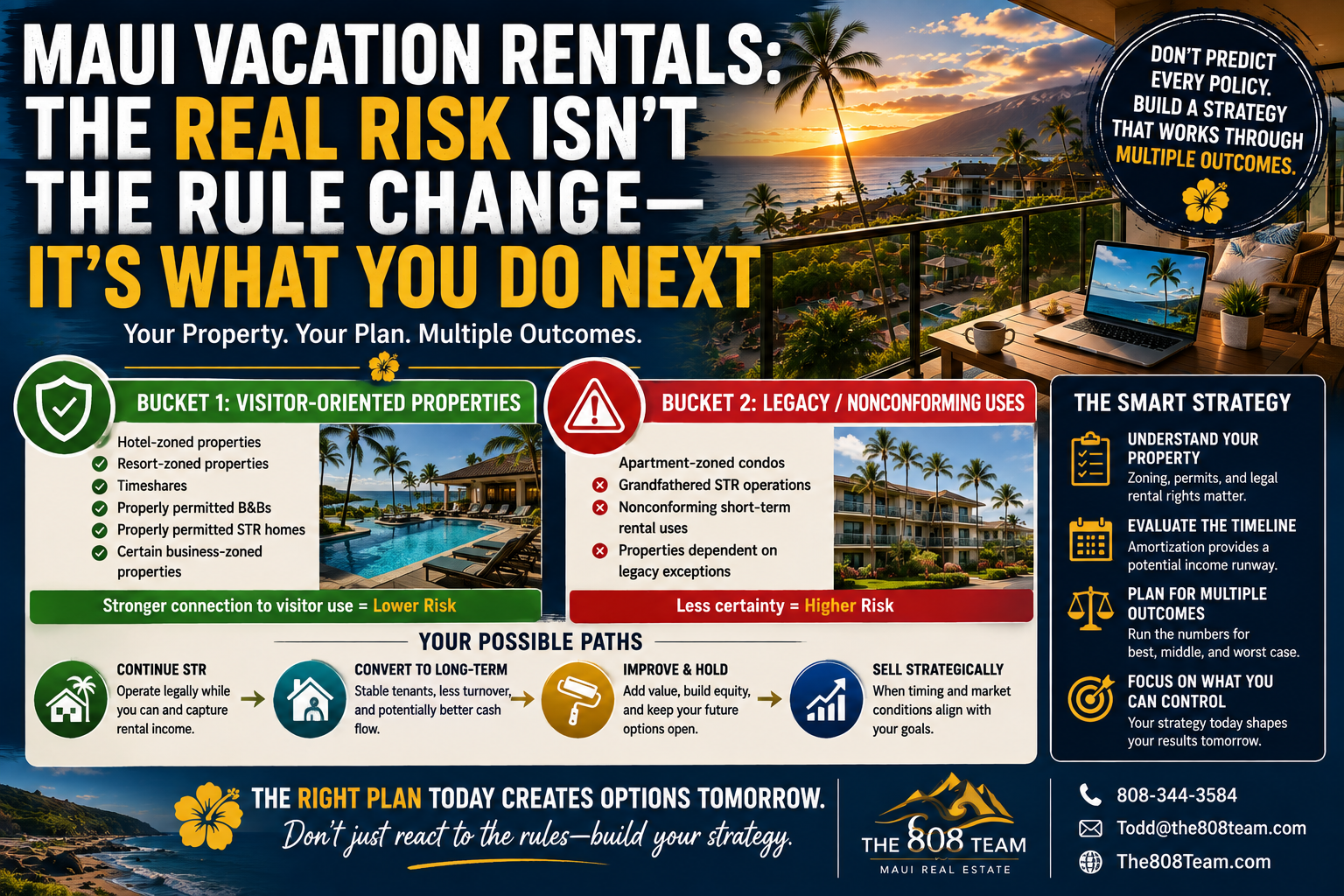
Maui Vacation Rentals: The Real Risk Isn’t the Rule Change—It’s What You Do Next

Maui vacation rentals have become one of the most misunderstood areas of the local real estate market.
One headline says short-term rentals are being restricted.
Another talks about lawsuits.
Another discusses new zoning categories.
Meanwhile, owners and buyers are left wondering what any of it actually means for the property they own—or want to buy.
Here’s the framework I use:
Don’t try to predict every future policy decision. Understand the property you’re buying and build a plan that works through multiple outcomes.
That starts with one fundamental distinction:
Protected use versus exposed use.
Not Every Vacation Rental Is in the Same Boat
A hotel-zoned condo and an apartment-zoned condo can both be listed on a vacation-rental platform.
A guest may never know the difference.
An investor absolutely should.
The property’s zoning, historical use, permits, and legal basis for short-term rental activity can dramatically affect its future risk.
That’s why blanket statements such as “Maui is banning vacation rentals” aren’t particularly useful.
The more useful question is:
Which properties are actually exposed?
A Two-Bucket Approach
When evaluating Maui vacation-rental risk, I would start by putting the property into one of two broad groups.
Bucket One: Visitor-Oriented Properties
Generally stronger categories include:
* Hotel-zoned properties
* Resort-zoned properties
* Timeshares
* Properly permitted B&Bs
* Properly permitted short-term rental homes
* Certain business-zoned properties where transient use is authorized
These properties have a much clearer connection between their intended use and visitor accommodation.
Bucket Two: Legacy or Nonconforming Vacation Rentals
The greater concern is:
* Apartment-zoned condos
* Grandfathered STR operations
* Nonconforming short-term rental uses
* Properties dependent on legacy exceptions
These properties can still be excellent assets.
But they require a different investment strategy.
The Key Concept: Amortization
One of the most important concepts for anyone involved in this market is amortization.
In this context, it essentially means a transition period.
Rather than ending an existing use immediately, a rule may provide operators with a defined amount of time before the restriction takes full effect.
Previous Maui policy actions have involved timelines extending several years into the future, including dates around 2029 for certain West Maui properties and 2031 for certain South Maui properties.
From an investment perspective, that changes everything.
You’re no longer looking at:
Income today → zero income tomorrow
You’re potentially looking at:
Income today → several years of income → strategic transition
That is a much more manageable problem.
How I Would Underwrite an Exposed Property
If I were analyzing an apartment-zoned vacation rental today, I would not use a single forecast.
I’d build three.
Scenario A: STR Continues
The property retains its ability to operate as a vacation rental.
This is the upside scenario.
Scenario B: STR Continues for a Limited Period
You earn rental income for several years and then transition to another use.
This is the scenario I would take very seriously.
Scenario C: STR Rights End
The property ultimately becomes:
* A long-term rental
* A personal residence
* Or a property that needs to be sold
If the investment still makes sense under Scenario B or C, the deal becomes much more interesting.
If it only works under Scenario A, you’re taking a much larger bet.
The Income Runway Is an Asset
This is a concept I think many investors overlook.
Suppose a property has a future STR deadline.
That doesn’t mean the rental income between now and then is worthless.
It’s an asset.
If you can legally generate meaningful net income for several years, that cash flow can:
* Pay down debt
* Build reserves
* Offset ownership costs
* Fund improvements
* Increase your equity
* Give you time to make a better exit decision
The mistake is valuing the property as though the income continues forever.
The other mistake is valuing it as though the income ends tomorrow.
Both are wrong.
The correct question is:
What is the value of the income I can reasonably earn during the remaining legal operating window?
What Happens After STR Use?
This is where your investment thesis becomes more important than the headline.
Long-Term Rental
A traditional lease may produce less gross revenue, but it can also reduce:
* Turnover
* Guest management
* Furnishing expenses
* Hospitality costs
* Booking expenses
Tax treatment can also change depending on the property and how it is used. In qualifying circumstances, long-term or owner-occupied use may result in more favorable property-tax treatment, potentially including homeowner exemptions.
The correct comparison is net economics, not gross rent.
Personal Residence
A property that no longer works as an STR investment could still work beautifully as a home.
For an owner who wants a Maui base, retirement property, or second home, the economics are different.
Sale
You can also exit.
But the market will know about the regulatory timeline.
That means your future sale price may depend heavily on how much STR value remains when you list.
Rezoning
And then there is the wildcard.
H3 and H4: Why Investors Are Watching
Potential H3 and H4 zoning pathways have created another layer of opportunity for some apartment-zoned complexes.
The basic idea is that certain properties that have historically operated more like visitor accommodations may have a pathway toward zoning that better reflects that use.
If successful, that could materially improve the long-term outlook for certain complexes.
But this is where disciplined investors separate themselves from speculators.
A possible zoning path is not the same as an approved zoning change.
Don’t price a property as though the rezoning has already happened.
Instead, ask:
What is the probability of success, and what am I paying today?
The HOA May Be More Important Than the Unit
If you’re considering an apartment-zoned condo, look beyond the four walls.
The HOA may play a major role in the property’s future.
Find out whether the association is:
* Investigating H3 or H4
* Working with land-use professionals
* Coordinating with county officials
* Building owner support
* Preparing applications
* Budgeting for legal or consulting expenses
A building with an organized, proactive association may have a very different outlook from one where owners aren’t aligned.
That doesn’t guarantee success.
But it changes the probability.
The Biggest Investor Mistake: Buying the Story
It’s easy to build an exciting narrative around a distressed Maui condo.
“It’s down 40%.”
“It used to make $60,000.”
“It could get rezoned.”
“Tourism will come back.”
“All I need is for one thing to go right.”
That’s not underwriting.
A discounted property can remain a bad investment if the future use doesn’t support the price.
The better question is:
What does the property need to be worth if the optimistic story doesn’t happen?
Don’t Ignore Historical Rental Performance
Historical rental income can still be useful.
For example, one-bedroom units in properties such as Maui Vista have traded around the mid-$300,000 range in recent market conditions, while similar units had historically generated significant gross vacation-rental revenue.
That doesn’t mean those historical numbers will automatically return.
And gross revenue is not profit.
But historical performance can help demonstrate just how dramatically regulatory uncertainty can affect pricing.
It gives investors a benchmark.
The job is then to determine whether today’s price already reflects too much pessimism—or whether it accurately reflects the risk.
A Five-Question Investment Test
Before buying an apartment-zoned vacation rental, I would ask five questions.
1. What is the legal basis for today’s rental use?
Don’t guess.
Verify it.
2. How much STR income is realistically available?
Use conservative assumptions.
3. What is the property worth as a long-term rental?
This establishes a downside reference point.
4. What is the probability of successful rezoning?
Don’t treat possibility as certainty.
5. Would I still want this property if the optimistic scenario fails?
If the answer is yes, you’re probably looking at a more durable investment thesis.
If the answer is no, you’re probably buying a policy bet.
What About Lawsuits?
Legal challenges may affect the future of Maui vacation-rental regulation.
But investors should distinguish between:
legal possibility
and
financial certainty.
Until a court actually changes enforcement or an applicable rule is otherwise modified, the existing framework should remain the basis of your underwriting.
If the law changes later, your model can change with it.
That’s much safer than assuming the outcome you want.
Three Types of Maui Buyers
I think this market makes the most sense for three types of buyers.
The Conservative Buyer
This person wants dependable use and minimal regulatory uncertainty.
For them, hotel-zoned and resort-zoned properties may make more sense.
The Value Investor
This buyer is comfortable with uncertainty if the price adequately compensates for it.
They may consider selected apartment-zoned condos—but only after rigorous due diligence.
The Strategic Investor
This buyer is willing to buy an asset with multiple potential outcomes:
* Continue STR use
* Benefit from rezoning
* Transition to long-term rental
* Use it personally
* Sell strategically
The more options an investment gives you, the more resilient the strategy can become.
The Best Question Isn’t “Will Maui Change the Rules?”
That question is almost impossible to answer with certainty.
A better question is:
“What happens to my investment under each plausible outcome?”
That’s how you turn regulatory uncertainty into something you can actually analyze.
FAQ
Are all Maui vacation rentals at risk?
No. Risk varies significantly depending on zoning, permits, historical use, and whether the property relies on grandfathered or nonconforming rights.
Which properties generally have the strongest position?
Hotel-zoned, resort-zoned, timeshare, and properly permitted visitor-oriented properties generally have a stronger foundation.
Why are apartment-zoned condos more complicated?
Many have historically operated as vacation rentals despite being in residential-oriented zoning categories, creating greater exposure when policymakers seek to reduce visitor use in housing stock.
Does an amortization period mean the property is safe?
No. It means you may have additional time to operate and plan. The eventual outcome still needs to be addressed.
Should rezoning be part of my investment calculation?
It can be part of the upside case, but I would not make an investment dependent on an unapproved zoning change.
Is long-term rental a realistic fallback?
For some properties, yes. The economics depend on rent, expenses, taxes, financing, HOA costs, and the property’s physical characteristics.
The Strategic Advantage Is Flexibility
The strongest investment isn’t necessarily the property with the highest projected vacation-rental income.
It’s the property with the most viable paths forward.
Imagine two condos.
Property A: Makes excellent STR income but has no realistic fallback if that use ends.
Property B: Makes good STR income, could potentially benefit from rezoning, works as a long-term rental, and would also make a desirable personal residence.
Even if Property A produces more today, Property B may have a much stronger risk-adjusted profile.
That’s the kind of thinking I would bring to this market.
What I Would Do Today
If I already owned an exposed apartment-zoned condo, I would first determine the exact regulatory timeline and maximize the value of the remaining legal operating period.
Then I’d prepare for multiple outcomes rather than waiting for one decision to be made for me.
If I were buying today, I would want:
* Verified zoning
* Verified rental rights
* Conservative rental projections
* A long-term rental fallback
* A clear understanding of any phase-out date
* HOA visibility
* An informed view of any rezoning effort
* An exit strategy
And most importantly, I would want the purchase price to compensate me for the uncertainty.
Final Takeaway
Maui vacation-rental regulation is complicated.
But complicated does not automatically mean uninvestable.
The real opportunity—and the real risk—comes from understanding the difference between properties that were designed and approved for visitor use and those that depend on grandfathered or nonconforming rights.
If you own an exposed property, you may have more time and more options than the headlines suggest.
If you’re buying one, you need to be much more selective.
And if you’re considering a property because it looks cheap, don’t stop at the discount.
Ask why it’s cheap.
Then determine whether the risk is already reflected in the price—or whether the market is correctly warning you about what comes next.
In Maui real estate, uncertainty is unavoidable.
The goal isn’t to eliminate it.
The goal is to buy, hold, and plan in a way that gives you multiple ways to win.
Should I Sell My Maui Vacation Rental Now?
Not necessarily. A rule change or future deadline doesn't automatically mean selling today is the best financial decision. Before selling, calculate the remaining legal income runway, current market value, long-term rental potential, possible zoning outcomes, tax consequences and what you would do with the proceeds. For some owners, selling may make sense. For others, continuing to operate, holding or transitioning the property may produce a better outcome.
Own a Maui Vacation Rental—or Thinking About Buying One?
The biggest mistake you can make right now is making a major real estate decision based on a headline.Your property matters more than the headline.
Its zoning, legal rental rights, regulatory timeline, HOA, historical income, long-term rental potential, possible zoning pathways, and current market value all affect what your best move may be.
If you already own an apartment-zoned Maui vacation rental, let's figure out exactly where your property stands and build a strategy for multiple outcomes.
That might mean continuing to operate while you legally can. It might mean preparing for long-term rental use, watching a rezoning effort, improving the property, holding, or positioning it for sale.
And if you're thinking about buying one of these condos because prices have dropped substantially, let's run the downside before we get excited about the upside.

Todd Hudson | The 808 Team
Keller Williams Realty Maui
📞 808-344-3584
✉️ Todd@the808team.com
Keller Williams Realty Maui
📞 808-344-3584
✉️ Todd@the808team.com
Not sure what to do with your Maui vacation rental?
Call or email me. Let's look at your specific property, your numbers, and your options—and build a strategy around what you can control.
The 808 Team Maui
| The 808 Team | Keller Williams Realty Maui
or another way