
Categories
Buying Maui Real EstatePublished September 4, 2026
Why Some Hawaii Properties Cost Less Than You Expect: Fee Simple vs. Leasehold Explained

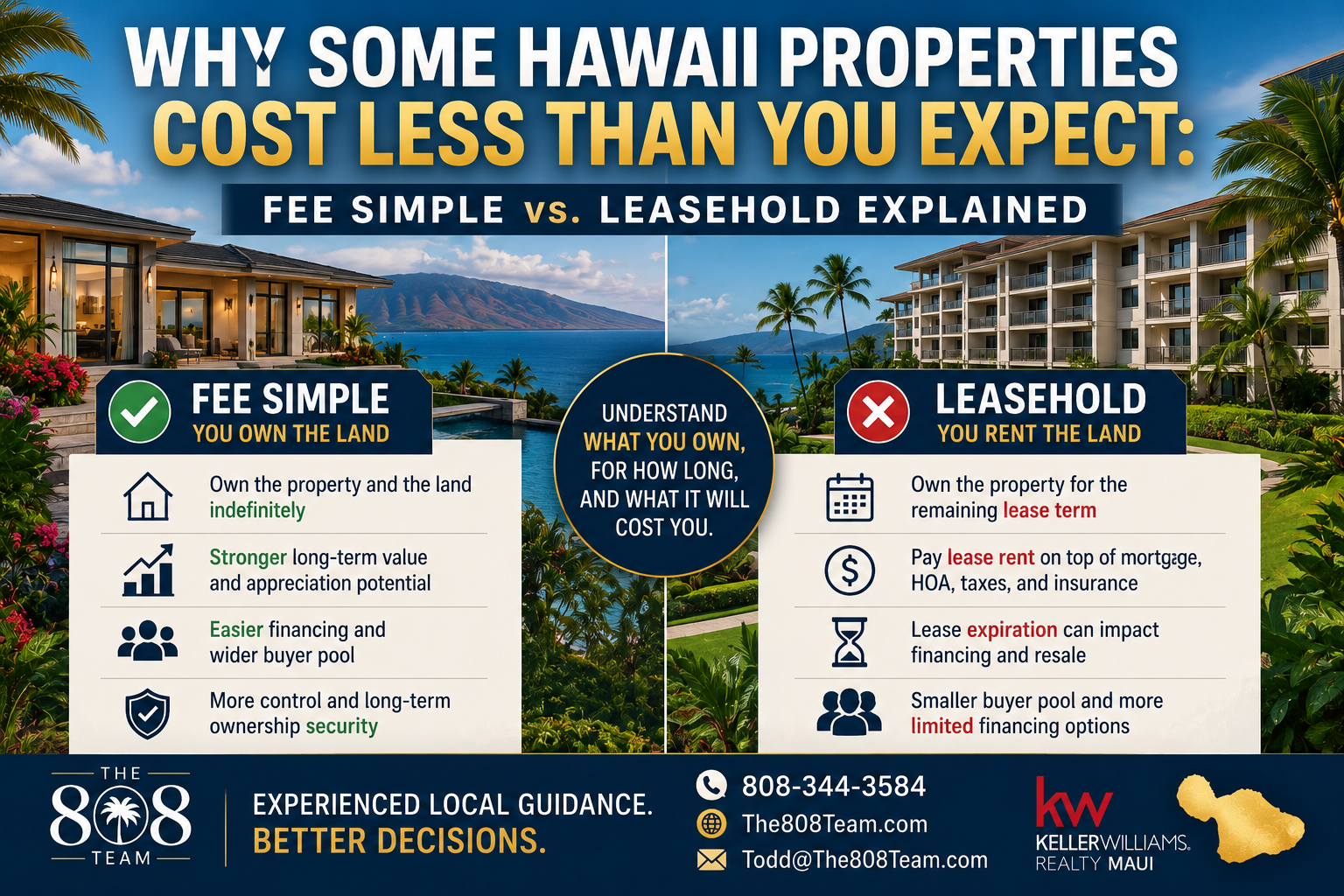
Why Some Hawaii Properties Cost Less Than You Expect: Fee Simple vs. Leasehold Explained
You're scrolling through Hawaii real estate listings and suddenly something doesn't make sense.
One condo is listed for $850,000.
Another property nearby looks similar—maybe even has an ocean view—and it's listed for $425,000.
Your first reaction might be:
What's wrong with it?
Sometimes there's absolutely nothing wrong with the property.
The difference may be two words that every Hawaii buyer needs to understand:
Fee simple vs. leasehold.
I've seen buyers get extremely excited after finding what appears to be an incredible deal online, only to discover that they weren't comparing the same type of ownership.
That's why one of the first things I want to know when a Hawaii property looks unusually inexpensive is:
What exactly are you buying—and for how long?
That question can tell you much more than the listing price.
Why Are Some Hawaii Condos So Cheap?
Some Hawaii condos appear unusually inexpensive because they are leasehold rather than fee simple.
With a leasehold property, the buyer generally does not own the underlying land. Instead, the buyer purchases an interest in the property for the remaining term of a land lease.
That lower purchase price can come with additional considerations, including lease rent, lease expiration, financing restrictions, future rent renegotiations and potentially a smaller pool of buyers when it's time to sell.
So when you see a Hawaii property priced dramatically below similar properties nearby, don't immediately assume you've found a bargain.
First, check the ownership structure.
Key Takeaways
- A surprisingly inexpensive Hawaii property may be leasehold rather than fee simple.
- Fee simple generally includes the property and the associated land ownership interest.
- Leasehold generally means another party owns the land and your ownership rights are subject to a land lease.
- Leasehold properties can have significantly lower purchase prices.
- Lease rent is generally separate from your mortgage, HOA dues, taxes and insurance.
- The remaining lease term can affect financing, resale and property value.
- Fee simple generally provides greater long-term certainty and attracts a larger buyer pool.
- Leasehold isn't automatically bad—it simply needs to fit the buyer's goals and timeline.
- Never compare Hawaii properties based solely on listing price.
What Does Fee Simple Mean in Hawaii?
Fee simple is the ownership structure most mainland buyers are already familiar with.
Generally speaking, you own the real estate and the associated land interest without an expiration date attached to a ground lease.
That typically gives you the ability to:
- Own the property indefinitely
- Sell it
- Finance or refinance it
- Transfer it
- Leave it to heirs
- Benefit from long-term appreciation without a ground-lease expiration hanging over the property
Fee simple doesn't mean ownership is free of expenses or restrictions.
You can still have:
- Property taxes
- HOA or maintenance fees
- Homeowners insurance
- Special assessments
- Zoning restrictions
- Condo rules
- Maintenance expenses
But the underlying ownership isn't counting down toward the expiration of a land lease.
If you want a more detailed comparison, read our complete guide to fee simple vs. leasehold condos on Maui.
What Does Leasehold Mean in Hawaii?
Leasehold is different.
Another person, trust, estate, company or entity owns the underlying land. You're purchasing rights associated with the property for the remaining term of the lease.
A leasehold property may involve:
- A significantly lower purchase price
- Monthly or annual lease rent
- A specific lease expiration date
- Scheduled lease-rent renegotiations
- Restrictions contained in the master lease
- Different financing requirements
- A potentially smaller resale market
This doesn't automatically make leasehold a bad purchase.
But it makes understanding the lease every bit as important as understanding the property.
Why Is Leasehold Property Usually Cheaper?
This is where the listing price starts making sense.
With fee simple ownership, land is part of the ownership equation.
With leasehold, it isn't owned in the same way.
You're buying a time-limited interest governed by a lease, which is why the market may value that property very differently.
Think about two Maui condos that appear relatively comparable.
One is fee simple.
The other has 30 years remaining on a ground lease.
Those aren't equivalent assets—even if the kitchens, views and square footage look almost identical.
The leasehold condo may legitimately be much cheaper.
But the discount exists for a reason.
The Listing Price Isn't the Real Cost
This is where buyers can get themselves into trouble.
Imagine a leasehold condo is $300,000 less than a comparable fee-simple property.
That sounds fantastic.
But now add:
- Mortgage payment
- Lease rent
- HOA dues
- Property taxes
- Insurance
- Maintenance
- Special assessments
Then consider what the property could be worth when you want to sell it.
Suddenly, comparing $400,000 against $700,000 doesn't tell you nearly enough.
This is one reason I encourage buyers to understand the hidden costs of owning a Maui condo before deciding whether a property actually fits their budget.
The cheapest property to buy isn't necessarily the cheapest property to own.
The Lease Clock Matters
This may be the single most important concept for a leasehold buyer.
A lease has an expiration date.
That means every year you own the property, there is generally one less year remaining on the lease.
Suppose you buy a property today with 40 years remaining.
If you own it for 15 years, the person buying it from you may be evaluating a property with only 25 years left.
That can change:
- Financing availability
- Buyer demand
- Resale value
- Negotiating leverage
- Your exit strategy
So don't only ask:
How many years are left today?
Ask:
How many years will be left when I probably want to sell?
That's a much better question.
Financing a Leasehold Property Can Be Different
A low purchase price doesn't help much if you can't obtain the financing you expected.
Lenders may have specific requirements regarding how long the lease must extend beyond the mortgage.
A commonly referenced benchmark is approximately five years beyond loan maturity.
That could mean roughly:
- 30-year mortgage → approximately 35 years remaining
- 20-year mortgage → approximately 25 years remaining
- 15-year mortgage → approximately 20 years remaining
But lender requirements can vary.
That's why I wouldn't make an offer on a leasehold property assuming conventional financing will work simply because the listing is active.
Talk to a lender familiar with Hawaii leasehold properties before you build your strategy around financing.
Lease Rent Can Change
Here's another number buyers need to understand.
Lease rent.
This is generally separate from your HOA or maintenance fee.
Depending on the lease, the amount may be fixed for a period and then subject to renegotiation or adjustment.
That's important because today's carrying cost may not be tomorrow's carrying cost.
Before buying, I want to know:
- Current lease rent
- Next renegotiation date
- How rent adjustments are calculated
- Historical rent changes
- Whether future increases can be estimated
- Whether there are caps or other protections
Don't evaluate a leasehold property using today's payment alone.
Understand what could happen during the entire period you expect to own it.
What Happens When a Lease Expires?
There isn't one universal answer.
The lease documents control what happens.
Depending on the specific lease, there may be provisions involving expiration, surrender, reversion, extension or other rights and obligations.
This is exactly why buyers shouldn't rely on something they heard from another owner or read in an old listing.
Read the documents.
If necessary, have the appropriate Hawaii attorney review them.
When you're buying leasehold, the paperwork isn't just paperwork.
It's part of what you're buying.
Can You Eventually Buy the Land?
Sometimes.
A fee interest may become available for purchase, potentially allowing an owner to convert from leasehold to fee simple.
That can obviously be valuable.
But here's the mistake I don't want buyers making:
Don't buy a leasehold property assuming you're eventually going to be offered the fee.
Unless there is an actual documented opportunity available, treat future fee conversion as a possibility—not your investment strategy.
Could Leasehold Still Be a Good Deal?
Absolutely.
There are situations where leasehold can make sense.
For example, someone may primarily want a Maui property to enjoy for the next 10 or 15 years.
They may have no intention of passing the property down to their children.
They may be paying cash.
And they may determine that the lower acquisition cost gives them access to a location or lifestyle they couldn't justify with a comparable fee-simple property.
That's a legitimate strategy.
Another buyer might be purchasing primarily for long-term appreciation, generational ownership and maximum future resale flexibility.
For that person, fee simple will generally be much more attractive.
Neither buyer is necessarily wrong.
They're buying for different reasons.
The Real Question: What Are You Trying to Accomplish?
This is something I talk about with Maui buyers constantly.
Don't start with:
Which property is cheapest?
Start with:
What am I trying to accomplish?
Are you:
- Moving to Maui permanently?
- Buying a second home?
- Planning to retire here?
- Looking for an investment?
- Buying a vacation property?
- Planning to own for five years?
- Planning to own for 30 years?
- Hoping to leave the property to your children?
The answers can completely change whether leasehold makes sense.
For buyers thinking about the entire ownership picture, I also recommend reading What Nobody Tells You About Owning Property on Maui.
Because whether you're buying fee simple or leasehold, island ownership comes with costs and realities that aren't always obvious from a Zillow listing.
Questions to Ask Before Buying a Leasehold Property in Hawaii
If you're seriously considering leasehold, these are questions I'd want answered before moving forward:
- Who owns the underlying land?
- What is the exact lease expiration date?
- How many years remain today?
- How many years will likely remain when I sell?
- What is the current lease rent?
- When is the next lease-rent renegotiation?
- How is the new rent calculated?
- Are there extension rights?
- Is the fee interest available for purchase?
- What happens when the lease expires?
- What restrictions does the lease place on the property?
- Can I rent the property?
- What financing is currently available?
- Are there disputes or litigation involving the lease?
- What have comparable leasehold units actually been selling for?
If you don't know the answers, you don't completely understand the property yet.
Don't Forget the HOA
Lease rent and HOA dues are two different things.
That's easy for first-time Hawaii buyers to miss.
A leasehold condo owner may potentially have:
Mortgage + Lease Rent + HOA + Taxes + Insurance + Maintenance
And special assessments can still happen.
Before buying any Maui condo—leasehold or fee simple—I recommend understanding the association's reserves, insurance coverage, maintenance history and upcoming capital projects.
My guide to HOA special assessments on Maui explains why this matters.
A $400,000 Condo Isn't Necessarily Cheaper Than a $700,000 Condo
This is probably the simplest way to summarize the entire conversation.
Don't compare:
$400,000 vs. $700,000
Compare:
Total cost + ownership rights + remaining lease term + financing + expected resale + your ownership timeline.
That's the real comparison.
This applies beyond leasehold, too. Maui buyers routinely underestimate insurance, utilities, maintenance, HOA costs and other expenses. Our guide to the hidden costs of owning property on Maui explains some of the other expenses I'd put into the equation.
Frequently Asked Questions About Hawaii Leasehold Property
Why are some Hawaii condos so much cheaper?
One common reason is that the property is leasehold rather than fee simple. The buyer is purchasing an interest subject to a land lease instead of the same ownership structure as fee-simple real estate. Lease rent, remaining lease term, financing limitations and future resale can all contribute to the lower market price.
Is leasehold property in Hawaii a bad investment?
Not necessarily. Leasehold can work when the purchase price, lease terms, ownership timeline and buyer's goals make sense together. The danger is buying based on the discounted price without understanding the lease.
Is fee simple better than leasehold?
For buyers seeking long-term ownership, appreciation, easier financing, generational ownership and a broader resale market, fee simple will generally be the preferred structure. Leasehold can still work for buyers with specific shorter-term or lifestyle objectives.
Can you finance a leasehold property in Hawaii?
Potentially, yes. But financing depends on the remaining lease term, the property and the lender's requirements. Financing options may become more limited as a lease approaches expiration.
Is lease rent included in the HOA fee?
Generally, no. Lease rent and HOA or maintenance fees are separate obligations. Buyers should verify the exact expenses for the individual property.
What happens when a Hawaii leasehold property reaches the end of its lease?
That depends on the specific lease. Buyers need to review the master lease and amendments to understand expiration, extension, surrender, reversion and other applicable provisions.
Can a Hawaii leasehold property become fee simple?
Sometimes an owner may be given an opportunity to purchase the fee interest. However, buyers should never assume a future fee purchase will become available unless there is a documented current opportunity.
A Smarter Way to Search Hawaii Real Estate
When you're scrolling through Hawaii listings, stop looking only at the number next to Price.
Look at:
Ownership: Fee simple or leasehold?
Lease: How many years remain?
Lease rent: What does it cost today and when does it reset?
HOA: What's included and how healthy is the association?
Financing: Can the property be financed on acceptable terms?
Use: Can you legally use the property the way you intend?
Resale: Who is likely to buy it from you later?
Timeline: How long do you realistically plan to own it?
That's how you determine whether something is actually inexpensive—or simply priced differently because you're buying something different.
Final Thoughts
Some of the prices you'll see while searching Hawaii real estate really can look too good to be true.
Sometimes they're legitimate opportunities.
Sometimes they're leasehold.
And sometimes they can be both.
The important thing is understanding why the property costs less.
Fee simple generally provides the stronger long-term ownership position, easier financing and a broader future buyer pool. Leasehold can still make sense for the right person when the price, lease terms and ownership timeline align.
But never buy a Hawaii property simply because it looks cheap compared with everything around it.
Understand what you own. Understand how long you own it. Understand what it will cost you. And understand what your exit looks like before you close.
Found a Maui Property That Looks Almost Too Cheap?
There's usually a reason—and understanding that reason before making an offer can save you from an expensive mistake.
Fee simple versus leasehold, remaining lease term, lease rent, HOA fees, financing restrictions and eventual resale can completely change whether an inexpensive-looking Maui property is actually a good value.
That's why I help buyers look beyond the listing price and understand exactly what they're buying before they commit.
Todd Hudson is a Maui Realtor® and Broker with The 808 Team at Keller Williams Realty Maui, ranked among the Top 1% of real estate professionals in Hawaii by sales volume. Todd works with buyers, sellers and investors throughout Maui and specializes in Maui residential real estate, condos, investment properties and vacation-rental real estate.
If you've found a Maui property online and you're wondering why it's priced so much lower than everything around it, send it to me. I'll help you understand what's behind the price.

Todd Hudson, REALTOR® | Broker
The 808 Team | Keller Williams Realty Maui
Maui Real Estate | Buyers • Sellers • Investors
Call or Text: 808-344-3584
Email: Todd@The808Team.com
Looking for an experienced Maui Realtor? Learn more about Todd Hudson and The 808 Team, or call or text me directly at 808-344-3584.

The 808 Team Maui
| The 808 Team | Keller Williams Realty Maui
or another way