
Categories
Maui Real Estate MarketPublished August 23, 2026
Why Some Maui Luxury Properties Hold Value Better Than Others

If you're trying to buy or sell in Maui right now, the biggest mistake is assuming every property is moving the same way. It isn't.
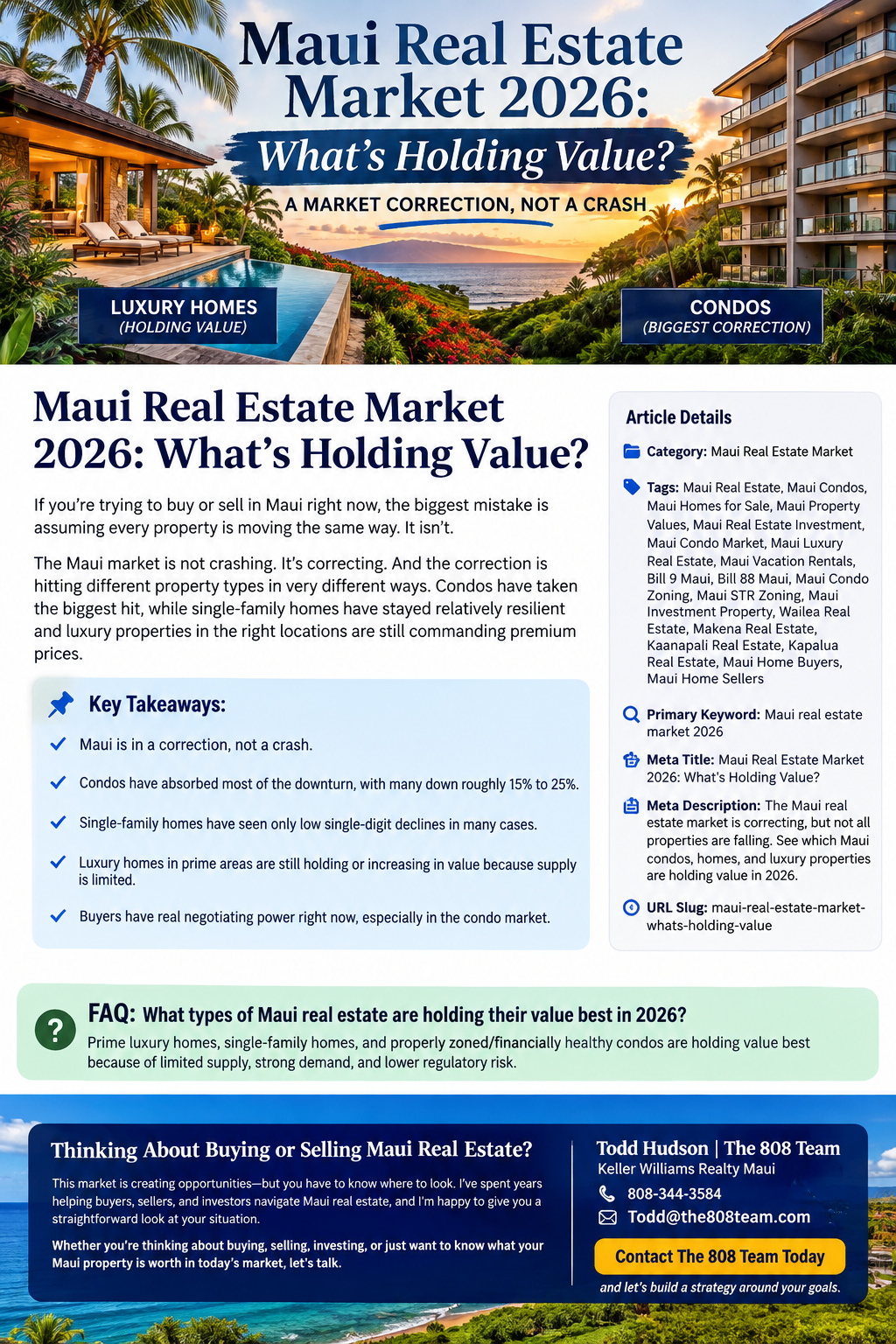
The Maui market is not crashing. It's correcting. And the correction is hitting different property types in very different ways. Condos have taken the biggest hit, while single-family homes have stayed relatively resilient and luxury properties in the right locations are still commanding premium prices.
Key takeaways
• Maui is in a correction, not a crash.
• Condos have absorbed most of the downturn, with many down roughly 15% to 25%.
• Single-family homes have seen only low single-digit declines in many cases.
• Luxury homes in prime areas are still holding or increasing in value because supply is limited.
• Zoning matters more than ever, especially for vacation-rental condos.
• Hotel- and resort-zoned condos generally carry less regulatory risk than apartment-zoned units affected by Bill 9 uncertainty.
• Turnkey, updated properties outperform fixers because buyers are more selective.
• HOA health, insurance costs, and fee simple vs. leasehold structure can dramatically affect long-term value.
• Buyers have real negotiating power right now, especially in the condo market.
• Sellers need to price accurately from day one instead of chasing the market down.
What determines whether a Maui property holds its value?
A Maui property's ability to hold value comes down to a few core drivers: scarcity, zoning, location, condition, carrying costs, and buyer demand.
When a property is rare, well-located, easy to own, and protected from major regulatory risk, it tends to hold up better. When it has zoning uncertainty, rising ownership costs, deferred maintenance, or a weaker buyer pool, it becomes more vulnerable in a correction.
Why Maui's market is splitting into tiers
The biggest shift in Maui real estate is that the market is no longer moving as one.
Instead, it's separating into tiers:
• Luxury homes in prime locations
• Standard single-family homes
• Condos with strong zoning and ownership profiles
• Condos with higher regulatory or cost risk
That matters because buyers are no longer paying broad-market prices for average inventory. They are becoming highly selective and rewarding properties with clear long-term upside.
Why luxury Maui homes are holding value better
Luxury homes are holding value better because there simply aren't many of them, especially the kind buyers want most.
A well-done luxury home in Wailea, Makena, Kaanapali, Kapalua, or select upcountry locations offers something hard to replace:
• Privacy
• Strong lifestyle appeal
• Limited nearby competition
• Scarce new construction
• Move-in-ready condition
Building a new luxury home in Maui is not quick or easy. In many cases, buying land and building can take two to three years, sometimes longer once design, permitting, labor, and construction realities are factored in. That delay supports the value of finished luxury inventory that is already complete.
What luxury buyers are really paying for
Luxury buyers are not just buying square footage. They are buying convenience, scarcity, and certainty.
The properties that tend to perform best usually have:
• Prime south side or west side location
• Ocean views or strong privacy
• High-end finishes
• No major renovation needs
• Strong insurance and ownership feasibility
• A lifestyle-first appeal, not just an investment story
This is why a unique, polished property that doesn't need work can still sell well even when median prices soften elsewhere.
Why single-family homes are more resilient than condos
Single-family homes in Maui have stayed stronger than condos for one simple reason: there is less supply and broader demand.
Not every buyer wants a condo. Many want a yard, more privacy, room for family, or a true neighborhood feel. That buyer demand exists independently of vacation-rental economics.
Lifestyle demand matters
Some segments of Maui real estate are driven heavily by investor math. Others are driven by owner-occupant and second-home lifestyle demand.
Properties with stronger lifestyle demand often hold up better because buyers are making decisions based on how they want to live, not just what the unit can earn on a nightly basis.
That distinction becomes especially important in a slower market.
Why condos have taken the biggest correction
Condos have seen the deepest correction, with many properties down roughly 15% to 25% over the last couple of years.
That doesn't mean every condo is a bad buy. It means buyers have to separate strong condos from vulnerable ones.
The main reasons condos have corrected more sharply include:
• Zoning uncertainty
• High inventory
• Buyer caution around future short-term rental rules
• Rising HOA costs
• Insurance concerns
• Special assessment risk
• More price-sensitive buyer demand
In a balanced condo market, inventory might sit around 200 to 300 units. With inventory well above that level, buyers gain leverage. More supply means more options, more scrutiny, and stronger negotiation power.
How zoning affects Maui condo values
Zoning is one of the most important drivers of condo value in Maui right now.
If a condo's future use as a vacation rental is uncertain, buyers will price in that risk immediately. A unit may produce strong rental income today, but if that use becomes restricted in the future, the value equation changes fast.
The core zoning question buyers need to ask
Before buying a condo, ask:
Is this unit hotel-zoned, resort-zoned, apartment-zoned, or otherwise restricted from short-term rentals?
That question is no longer optional. It directly affects future income potential, resale value, and buyer demand.
Bill 9 and the two-tier condo market
Bill 9 has created a major divide between condo properties.
Apartment-zoned condos that have operated as vacation rentals may face future limitations depending on location and implementation timelines. That has introduced a layer of risk that buyers can no longer ignore.
By contrast, hotel- and resort-zoned condos are generally in a more secure position for continued vacation-rental use. That makes them more attractive to many buyers, even if they trade at a premium.
Bill 88 and possible reclassification
Bill 88 adds another layer of nuance.
Some properties that were built, marketed, and operated like vacation rentals may have a path toward different zoning treatment. That could create opportunities in select cases, but buyers should avoid making assumptions and should verify exactly how a property is classified and what future use rights may look like.
The ownership costs buyers cannot ignore
Price is only one part of the Maui condo equation. The bigger issue is often cost to own.
A unit that looks attractive on paper can become much less attractive once buyers dig into HOA structure, assessments, insurance, and land tenure.
HOA quality can make or break value
A healthy HOA protects property values. A weak HOA creates uncertainty.
Before buying, review:
• Reserve funding
• History of dues increases
• Pending or likely special assessments
• Deferred maintenance
• Long-term capital improvement needs
• Building condition and management quality
If dues have been increasing aggressively year after year, that is a warning sign. If major repairs are coming and reserves are thin, buyers need to factor that into their offer.
Fee simple vs. leasehold
This is another major differentiator.
With fee simple, once a mortgage is paid off, ownership costs can become much more manageable over time.
With leasehold, the lease payment remains part of the ownership burden. That can materially affect long-term value, buyer demand, and affordability.
As a rule, fee simple ownership tends to be easier to underwrite, easier to resell, and more stable over the long run.
Insurance is now part of the value conversation
Insurance costs have become a more important factor, especially in areas where risk perceptions have changed.
If a property carries unusually high insurance costs, that will affect affordability and limit the buyer pool. Even a great property can face resistance if ownership costs feel too high relative to alternatives.
Why turnkey beats fixer in this market
In a slower market, buyers get picky. That is exactly what is happening now.
The properties performing best are often the ones that let a buyer move quickly with minimal friction. Buyers do not want to inherit projects, unknown repair costs, or a long punch list after closing.
What buyers prefer right now
The strongest-performing listings usually offer:
• Updated interiors
• Strong maintenance history
• Clean inspections
• Good cooling systems
• Furniture or rental-readiness where relevant
• No obvious deferred work
A buyer may still purchase a property that needs work, but they will expect a price discount and often ask for concessions during negotiations.
How buyers can win in the current Maui market
This is one of the best negotiation environments buyers have seen in years, especially for condos.
With more inventory and fewer multiple-offer situations, buyers can be strategic.
Buyer playbook
• Verify zoning before analyzing rental income
• Review HOA documents in detail
• Check for special assessments and reserve weakness
• Compare fee simple against leasehold carefully
• Use inspection findings to negotiate
• Ask for upgrades or credits when needed
• Favor turnkey properties unless the discount is substantial
If a property has regulatory uncertainty, ownership-cost risk, or obvious improvement needs, buyers should not pay premium pricing.
How sellers can protect value and sell faster
Sellers still have opportunities, but pricing strategy matters more than ever.
The worst move in a correcting market is starting too high and cutting repeatedly. That approach makes listings stale and often leads to a weaker final result.
Seller playbook
• Price at market value from day one
• Consider pricing slightly under competing inventory to drive attention
• Complete repairs before listing
• Get a pre-listing inspection if possible
• Highlight zoning strength and ownership advantages clearly
• Present the property as turnkey
• Time the sale for stronger seasonal demand if there is no urgency
A clean, well-prepared listing with realistic pricing has a much better chance of attracting serious buyers quickly.
Common mistakes to avoid
Here are the biggest mistakes I see buyers and sellers make in this market:
• Assuming the entire Maui market is dropping equally
• Valuing condos based only on current rental income
• Ignoring zoning and future regulatory risk
• Overlooking HOA financial health
• Underestimating insurance costs
• Treating leasehold like fee simple
• Overpricing a listing and chasing the market down
• Underestimating how much buyers value turnkey condition
FAQ
Is the Maui real estate market crashing?
No. The Maui market is better described as a correction, not a crash. Condos have taken the largest hit, while single-family homes have remained relatively stable and luxury properties in prime areas have often stayed strong.
Are Maui condos a bad investment right now?
Not necessarily. The key is selecting the right condo. Zoning, HOA health, ownership costs, and long-term rental eligibility matter more than ever.
Why are luxury homes in Maui performing better?
Luxury homes benefit from limited supply, slow new-construction timelines, strong lifestyle demand, and buyer preference for unique, move-in-ready properties in prime locations.
What areas tend to hold value best?
Properties in areas like Wailea, Makena, Kaanapali, Kapalua, and select lifestyle-driven parts of upcountry tend to draw stronger demand, especially at the luxury end.
What should condo buyers review before making an offer?
At minimum, review zoning, HOA financials, reserve studies, dues history, insurance costs, special assessment exposure, ownership structure, and any future risk to vacation-rental use.
Are buyers able to negotiate in Maui right now?
Yes. Buyers have more leverage than they have had in years, particularly in the condo segment. Negotiations on price, repairs, improvements, and credits are much more common.
Next steps
If you only do three things before buying or selling in Maui, do these:
• Separate the market by property type. Do not analyze condos, single-family homes, and luxury properties as if they behave the same.
• Verify the long-term ownership story. Zoning, HOA strength, insurance, and fee structure matter as much as list price.
• Focus on scarcity and condition. Rare, well-located, turnkey properties continue to outperform.
The Maui market still offers strong opportunity. But the winners in this market will be the people who look past headlines, study the details, and make decisions based on long-term durability rather than short-term hype.
The Maui market is not crashing. It's correcting. And the correction is hitting different property types in very different ways. Condos have taken the biggest hit, while single-family homes have stayed relatively resilient and luxury properties in the right locations are still commanding premium prices.
Key takeaways
• Maui is in a correction, not a crash.
• Condos have absorbed most of the downturn, with many down roughly 15% to 25%.
• Single-family homes have seen only low single-digit declines in many cases.
• Luxury homes in prime areas are still holding or increasing in value because supply is limited.
• Zoning matters more than ever, especially for vacation-rental condos.
• Hotel- and resort-zoned condos generally carry less regulatory risk than apartment-zoned units affected by Bill 9 uncertainty.
• Turnkey, updated properties outperform fixers because buyers are more selective.
• HOA health, insurance costs, and fee simple vs. leasehold structure can dramatically affect long-term value.
• Buyers have real negotiating power right now, especially in the condo market.
• Sellers need to price accurately from day one instead of chasing the market down.
What determines whether a Maui property holds its value?
A Maui property's ability to hold value comes down to a few core drivers: scarcity, zoning, location, condition, carrying costs, and buyer demand.
When a property is rare, well-located, easy to own, and protected from major regulatory risk, it tends to hold up better. When it has zoning uncertainty, rising ownership costs, deferred maintenance, or a weaker buyer pool, it becomes more vulnerable in a correction.
Why Maui's market is splitting into tiers
The biggest shift in Maui real estate is that the market is no longer moving as one.
Instead, it's separating into tiers:
• Luxury homes in prime locations
• Standard single-family homes
• Condos with strong zoning and ownership profiles
• Condos with higher regulatory or cost risk
That matters because buyers are no longer paying broad-market prices for average inventory. They are becoming highly selective and rewarding properties with clear long-term upside.
Why luxury Maui homes are holding value better
Luxury homes are holding value better because there simply aren't many of them, especially the kind buyers want most.
A well-done luxury home in Wailea, Makena, Kaanapali, Kapalua, or select upcountry locations offers something hard to replace:
• Privacy
• Strong lifestyle appeal
• Limited nearby competition
• Scarce new construction
• Move-in-ready condition
Building a new luxury home in Maui is not quick or easy. In many cases, buying land and building can take two to three years, sometimes longer once design, permitting, labor, and construction realities are factored in. That delay supports the value of finished luxury inventory that is already complete.
What luxury buyers are really paying for
Luxury buyers are not just buying square footage. They are buying convenience, scarcity, and certainty.
The properties that tend to perform best usually have:
• Prime south side or west side location
• Ocean views or strong privacy
• High-end finishes
• No major renovation needs
• Strong insurance and ownership feasibility
• A lifestyle-first appeal, not just an investment story
This is why a unique, polished property that doesn't need work can still sell well even when median prices soften elsewhere.
Why single-family homes are more resilient than condos
Single-family homes in Maui have stayed stronger than condos for one simple reason: there is less supply and broader demand.
Not every buyer wants a condo. Many want a yard, more privacy, room for family, or a true neighborhood feel. That buyer demand exists independently of vacation-rental economics.
Lifestyle demand matters
Some segments of Maui real estate are driven heavily by investor math. Others are driven by owner-occupant and second-home lifestyle demand.
Properties with stronger lifestyle demand often hold up better because buyers are making decisions based on how they want to live, not just what the unit can earn on a nightly basis.
That distinction becomes especially important in a slower market.
Why condos have taken the biggest correction
Condos have seen the deepest correction, with many properties down roughly 15% to 25% over the last couple of years.
That doesn't mean every condo is a bad buy. It means buyers have to separate strong condos from vulnerable ones.
The main reasons condos have corrected more sharply include:
• Zoning uncertainty
• High inventory
• Buyer caution around future short-term rental rules
• Rising HOA costs
• Insurance concerns
• Special assessment risk
• More price-sensitive buyer demand
In a balanced condo market, inventory might sit around 200 to 300 units. With inventory well above that level, buyers gain leverage. More supply means more options, more scrutiny, and stronger negotiation power.
How zoning affects Maui condo values
Zoning is one of the most important drivers of condo value in Maui right now.
If a condo's future use as a vacation rental is uncertain, buyers will price in that risk immediately. A unit may produce strong rental income today, but if that use becomes restricted in the future, the value equation changes fast.
The core zoning question buyers need to ask
Before buying a condo, ask:
Is this unit hotel-zoned, resort-zoned, apartment-zoned, or otherwise restricted from short-term rentals?
That question is no longer optional. It directly affects future income potential, resale value, and buyer demand.
Bill 9 and the two-tier condo market
Bill 9 has created a major divide between condo properties.
Apartment-zoned condos that have operated as vacation rentals may face future limitations depending on location and implementation timelines. That has introduced a layer of risk that buyers can no longer ignore.
By contrast, hotel- and resort-zoned condos are generally in a more secure position for continued vacation-rental use. That makes them more attractive to many buyers, even if they trade at a premium.
Bill 88 and possible reclassification
Bill 88 adds another layer of nuance.
Some properties that were built, marketed, and operated like vacation rentals may have a path toward different zoning treatment. That could create opportunities in select cases, but buyers should avoid making assumptions and should verify exactly how a property is classified and what future use rights may look like.
The ownership costs buyers cannot ignore
Price is only one part of the Maui condo equation. The bigger issue is often cost to own.
A unit that looks attractive on paper can become much less attractive once buyers dig into HOA structure, assessments, insurance, and land tenure.
HOA quality can make or break value
A healthy HOA protects property values. A weak HOA creates uncertainty.
Before buying, review:
• Reserve funding
• History of dues increases
• Pending or likely special assessments
• Deferred maintenance
• Long-term capital improvement needs
• Building condition and management quality
If dues have been increasing aggressively year after year, that is a warning sign. If major repairs are coming and reserves are thin, buyers need to factor that into their offer.
Fee simple vs. leasehold
This is another major differentiator.
With fee simple, once a mortgage is paid off, ownership costs can become much more manageable over time.
With leasehold, the lease payment remains part of the ownership burden. That can materially affect long-term value, buyer demand, and affordability.
As a rule, fee simple ownership tends to be easier to underwrite, easier to resell, and more stable over the long run.
Insurance is now part of the value conversation
Insurance costs have become a more important factor, especially in areas where risk perceptions have changed.
If a property carries unusually high insurance costs, that will affect affordability and limit the buyer pool. Even a great property can face resistance if ownership costs feel too high relative to alternatives.
Why turnkey beats fixer in this market
In a slower market, buyers get picky. That is exactly what is happening now.
The properties performing best are often the ones that let a buyer move quickly with minimal friction. Buyers do not want to inherit projects, unknown repair costs, or a long punch list after closing.
What buyers prefer right now
The strongest-performing listings usually offer:
• Updated interiors
• Strong maintenance history
• Clean inspections
• Good cooling systems
• Furniture or rental-readiness where relevant
• No obvious deferred work
A buyer may still purchase a property that needs work, but they will expect a price discount and often ask for concessions during negotiations.
How buyers can win in the current Maui market
This is one of the best negotiation environments buyers have seen in years, especially for condos.
With more inventory and fewer multiple-offer situations, buyers can be strategic.
Buyer playbook
• Verify zoning before analyzing rental income
• Review HOA documents in detail
• Check for special assessments and reserve weakness
• Compare fee simple against leasehold carefully
• Use inspection findings to negotiate
• Ask for upgrades or credits when needed
• Favor turnkey properties unless the discount is substantial
If a property has regulatory uncertainty, ownership-cost risk, or obvious improvement needs, buyers should not pay premium pricing.
How sellers can protect value and sell faster
Sellers still have opportunities, but pricing strategy matters more than ever.
The worst move in a correcting market is starting too high and cutting repeatedly. That approach makes listings stale and often leads to a weaker final result.
Seller playbook
• Price at market value from day one
• Consider pricing slightly under competing inventory to drive attention
• Complete repairs before listing
• Get a pre-listing inspection if possible
• Highlight zoning strength and ownership advantages clearly
• Present the property as turnkey
• Time the sale for stronger seasonal demand if there is no urgency
A clean, well-prepared listing with realistic pricing has a much better chance of attracting serious buyers quickly.
Common mistakes to avoid
Here are the biggest mistakes I see buyers and sellers make in this market:
• Assuming the entire Maui market is dropping equally
• Valuing condos based only on current rental income
• Ignoring zoning and future regulatory risk
• Overlooking HOA financial health
• Underestimating insurance costs
• Treating leasehold like fee simple
• Overpricing a listing and chasing the market down
• Underestimating how much buyers value turnkey condition
FAQ
Is the Maui real estate market crashing?
No. The Maui market is better described as a correction, not a crash. Condos have taken the largest hit, while single-family homes have remained relatively stable and luxury properties in prime areas have often stayed strong.
Are Maui condos a bad investment right now?
Not necessarily. The key is selecting the right condo. Zoning, HOA health, ownership costs, and long-term rental eligibility matter more than ever.
Why are luxury homes in Maui performing better?
Luxury homes benefit from limited supply, slow new-construction timelines, strong lifestyle demand, and buyer preference for unique, move-in-ready properties in prime locations.
What areas tend to hold value best?
Properties in areas like Wailea, Makena, Kaanapali, Kapalua, and select lifestyle-driven parts of upcountry tend to draw stronger demand, especially at the luxury end.
What should condo buyers review before making an offer?
At minimum, review zoning, HOA financials, reserve studies, dues history, insurance costs, special assessment exposure, ownership structure, and any future risk to vacation-rental use.
Are buyers able to negotiate in Maui right now?
Yes. Buyers have more leverage than they have had in years, particularly in the condo segment. Negotiations on price, repairs, improvements, and credits are much more common.
Next steps
If you only do three things before buying or selling in Maui, do these:
• Separate the market by property type. Do not analyze condos, single-family homes, and luxury properties as if they behave the same.
• Verify the long-term ownership story. Zoning, HOA strength, insurance, and fee structure matter as much as list price.
• Focus on scarcity and condition. Rare, well-located, turnkey properties continue to outperform.
The Maui market still offers strong opportunity. But the winners in this market will be the people who look past headlines, study the details, and make decisions based on long-term durability rather than short-term hype.
Thinking About Buying or Selling Maui Real Estate?
This market is creating opportunities—but you have to know where to look.The difference between a great Maui real estate purchase and an expensive mistake can come down to zoning, HOA financials, insurance, rental eligibility, location, and the specific property you choose. And if you're selling, pricing and positioning your property correctly from day one matters more than ever.
I've spent years helping buyers, sellers, and investors navigate Maui real estate, and I'm happy to give you a straightforward look at your situation.
Whether you're thinking about buying, selling, investing, or just want to know what your Maui property is worth in today's market, let's talk.

Todd Hudson | The 808 Team
Todd@the808Team.com
Keller Williams Realty Maui
📞 808-344-3584
Ready to make a move? Contact The 808 Team today and let's build a strategy around your goals.
Keller Williams Realty Maui
📞 808-344-3584
Ready to make a move? Contact The 808 Team today and let's build a strategy around your goals.

The 808 Team Maui
| The 808 Team | Keller Williams Realty Maui
or another way